- A0 — Overview
- A1 — Stopping the violence: lowering the conflict barrier to the Ebola response
- A2 — Beyond contact tracing: community-based monitoring as the primary detection strategy
- A3 — Bounding the outbreak: controlling movement inside the DRC
- A4 — Getting resources to the ground: Coordinating procurement and logistics
- A5 — Building trust: delivering clear information through the voices and channels communities already trust
WHN Science Communications
Stopping Ebola in the DRC: Community-Led Response
Cite
Version 1.0
A0 — Overview
The Ebola outbreak in the Democratic Republic of the Congo is out of control. This is not a warning about what could happen. It is a description of what is happening now. Cases are growing, the growth is accelerating, and the contact-tracing strategy meant to contain it has failed.
Contact tracing is consistently reported to be falling short of its coverage targets [1]. The outbreak has outgrown the method. The clearest sign of that failure is apparent from WHO’s own figure; roughly four in five new cases are being found outside the known chains of transmission [2]. When most cases appear in people whom no one was watching, contact tracing can no longer prevent disease spread. It is discovering the outbreak after the fact, one surprise at a time. The reasons this was inevitable at this scale are laid out in the accompanying document. The conclusion is not in doubt: the hope that the current process will bring this under control is lost.
At this number of cases, the spread beyond the DRC is no longer a distant risk. Every additional case raises the chance that Ebola travels across the community and across borders. Uganda has shown that a case brought in can be stopped, and its teams have done extraordinary work, the more striking because their border with the DRC is one where informal, unofficial crossing is the rule, not the exception. Their success came from preventing the informal movement from causing outbreaks, not from screening at official gates. One case reached France and was declared on arrival, so further spread was prevented [3]. But these successes must now scale to meet a much larger burden across all countries. And the challenge grows with the pace of new cases, which is accelerating.
In view of the conditions on the ground, Africa CDC and WHO have called for urgent community-led action [4]. This is what worked in West Africa, and this document presents a plan for its execution.
Stopping this outbreak requires work on five fronts. Each one is essential. None of them succeeds alone. The purpose of this document is to explain how the outbreak can be stopped. The most important people responding to it are the members of the communities where the outbreak is occurring. We are looking for people who want to enable their actions with coordination, information, and resources. If you are one of them, this document is for you.
1. Lower the conflict barrier
Violence drives transmission and blocks the response at the same time. It scatters populations, destroys the trust that monitoring depends on, and makes whole areas impossible to reach. Nothing else on this list works where response teams are attacked and communities are displaced. It seems that the war must be stopped before the disease can be addressed. A single outbreak-wide pause, focused solely on Ebola rather than the underlying conflict, would be the best outcome and worth pursuing. But it is also the least likely: it moves at the pace of stalled peace talks, and it cannot bind the fragmented militias where the outbreak core sits.
The more important point is that the response proposed here needs far less conflict resolution than it first appears. Community-based monitoring (see next item on this list, Front 2) is carried out by members of each community, who watch for illness among their own. No teams crossing front lines, nothing moving through the war zone but knowledge, simple tools, and support. That turns this front from winning one piece into a ladder of smaller asks, worked zone by zone. Most often, the ask is simply permission for a community to watch and protect its own sick. Where no authority will deal, communities organize to protect themselves, as they did in West Africa.
Here the need is for people who can engage the parties, the mediators, or the communities directly, carrying the message that stopping Ebola is in everyone’s interest.
2. Put community monitoring first
Contact tracing assumes you can follow the chain from one case to the next. That is no longer possible. With most cases appearing outside the known network, the chain is lost, and a strategy built on following it can only fall further behind.
The alternative is to find cases where they are, by monitoring communities directly rather than only the contacts of known cases. This means door-to-door monitoring: regular checks for fever and other symptoms across affected communities, so that cases are found early and isolated fast, and transmission is interrupted where it is actually occurring. It requires local teams, simple tools, and clear protocols. This front is the operational core of the response and is detailed in the accompanying document.
A fair question is why this should succeed where contact tracing has failed, under the same conditions of mistrust and limited access. The answer lies in who is watched and who is watching. Contact tracing must determine which individuals to monitor, and finding and following the right people becomes harder as cases multiply. Community monitoring does not select: everyone is checked, so no one is missed, and checking everyone in a community is simpler than identifying the exposed individuals within it. And the checking is done by people watching over their own neighbors and family, drawing on trust that already exists and does not depend on outside access. It is a different mechanism, not a faster version of the current one.
3. Control movement between communities
Screening and slowing travel at the country border is the immediate and most readily achievable part. The larger task, and the neglected one, is controlling movement between communities inside the country. This outbreak is not fixed in place; it travels with people, and every newly seeded community is a fresh outbreak to fight from scratch.
Control the movement between communities and you bound the outbreak, and a bounded outbreak, held to a limited area, can be driven to zero on ground that is no longer expanding beneath you. This is a firebreak: it puts out nothing by itself, but it makes the fight winnable. It involves practical measures begun now and improved over time: discouraging non-essential travel, establishing community-run checkpoints, and provisioned quarantine at the origin for the travel that must still happen. It is the close companion of community monitoring. The two work as one system: monitoring finds the cases within each community, and movement control keeps them from seeding the next one. Each strengthens the other. Here, the need is for people who can advise communities as they set these up and run them.
4. Get resources to the ground
Monitoring and protection depend on physical things: thermometers to detect fever, protective equipment to keep responders and communities safe, and the supplies needed to isolate and care for those with early symptoms. Teams cannot do the work without them.
Coordination is the work of this front: gathering information about what is needed, identifying sources, funders, and shippers, and tracking where it goes. Coordinated, these steps put supplies into the hands of those doing the work, where and when they are needed.
Supplies for health workers require particular attention. Health workers are among the most exposed people in the outbreak [5]. The treatment of patients is not the direct subject of this plan. But the protection of the people who provide that treatment is a supply problem, and it belongs to this front. Working directly with community partners, NGOs, national and international response actors, not only mobilizing donations, but also partnerships with manufacturers, institutions, and humanitarian organizations, and supporting reliable delivery to frontline teams.
5. Build trust and deliver clear information
Disinformation is a driver of this outbreak. Where communities do not trust responders, monitoring fails, isolation fails, and every other effort fails with them. At the same time, people need accurate and usable information about how the disease spreads and how to protect themselves and their families, including safe burial. Unsafe burial has driven transmission in every major Ebola outbreak.
This means finding out what communities already believe and need, then delivering clear information through voices and channels they already trust: community, political, and religious leaders, and the local radio and networks people already rely on. Survivors, where they are willing, often become credible voices: they can say what happens inside a treatment center because they have been there, and their coming home is itself the message that there is something to be gained. It calls for people who understand the local context and can communicate within it, and for the material that makes accurate information easy to find, read, and act on.
A note on vaccines. Vaccination helped end the DRC’s own 2018–2020 outbreak, so it is natural to ask why it is not one of the fronts here. The reason is that this outbreak is caused by the Bundibugyo strain, for which no vaccine has yet been approved. Doses have recently been allocated to the DRC to protect health and response workers and to conduct trials toward approval [6], a welcome step for those most exposed but not a population-wide answer. Work toward a proven vaccine deserves attention and support for the institutions engaged in developing it, but the response taking place now cannot wait. West Africa’s epidemic was ended without a vaccine, and its lessons can be applied here.
These five fronts are what it will take to stop this outbreak in the DRC and to keep it from becoming a wider emergency. The window for doing so is closing, and it closes a little more with every case. If you see the front where you can help, this is the moment to step in.
References
[1] UN News, 9 June 2026 — WHO reported contact-tracing coverage near 60% against a 95% target as of early June. https://news.un.org/en/story/2026/06/1167679
[2] WHO Director-General, opening remarks at the media briefing, 16 July 2026: “more than 80% of new cases are being detected outside known contact lists, showing that transmission chains are still being missed.” https://www.who.int/news-room/speeches/item/who-director-general-s-opening-remarks-at-the-media-briefing—16-july-2026 (corroborated by UN News, 16 July 2026: https://news.un.org/en/story/2026/07/1167959).
[3] Ministère de la Santé et de l’Accès aux Soins (France) / France 24, 24 June 2026 — physician returning from DRC confirmed as France’s first case; reported on arrival; contacts traced, no further spread. https://www.france24.com/en/france/20260624-france-confirms-first-ebola-case-in-doctor-returning-from-dr-congo-mission
[4] Africa CDC and WHO, joint statement, 6 August 2026: “Africa CDC and WHO call for urgent, community-led action to contain Ebola in the DRC.” https://www.who.int/news/item/06-08-2026-africa-cdc-and-who-call-for-urgent–community-led-action-to-contain-ebola-in-the-drc
[5] Africa CDC. “Africa CDC Calls for Stronger Protection of Responders.” 11 July 2026. Dr Jean Kaseya, Director-General: “We honour the 112 health workers infected in DRC since this outbreak began, including the 35 who lost their lives” (figures as of 9 July 2026). https://africacdc.org/news-item/africa-cdc-calls-for-stronger-protection-of-responders/
[6] WHO. “WHO and Africa CDC, allocation of Ebola vaccines to the DRC,” 20 August 2026 — 70,000 doses of Ervebo allocated for responders and a Phase 3 trial; Ervebo is licensed for Zaire ebolavirus, not the Bundibugyo strain of this outbreak. https://www.who.int/news/item/20-08-2026-who-and-africa-cdc-welcome-the-allocation-of-ebola-vaccines-to-the-democratic-republic-of-the-congo
The response set
Five component notes that each stand alone and together form one strategy:
- A0 — Overview — this note
- A1 — Stopping the violence
- A2 — Community-based monitoring
- A3 — Movement control
- A4 — Resources to the ground
- A5 — Information / countering disinformation
A1 — Stopping the violence: lowering the conflict barrier to the Ebola response
Abstract
The DRC Ebola outbreak and response are unfolding inside an active war: armed groups contest the mining districts where the outbreak began, responders have been attacked and taken hostage, and more than 900,000 people are displaced. The natural conclusion is that the fighting must be stopped before the disease can be addressed. That is half right. A single outbreak-wide truce would be the best outcome and should be pursued—but it is the least likely, it moves at the pace of stalled peace talks, and it cannot bind the fragmented militias where the outbreak core sits. The more important point is that the primary response, community-based monitoring (A2), needs far less conflict resolution than an outsider-run response does, because each community carries it out inside its own space rather than by teams sent across front lines. That turns Front 1’s task from winning one peace into securing, zone by zone, that a community be allowed to watch and protect its own sick—the ladder of asks, and the voluntary kit it delivers, that this note sets out.
The war around the outbreak
The outbreak is centred in Ituri and the eastern provinces, contested by M23/AFC, CODECO, the ADF, and pro-government Wazalendo militias, with Rwanda and Uganda entangled in the war economy that sustains the fighting. Response teams have been attacked and health workers taken hostage, as in the 2018–2020 epidemic, when a militarized, escorted response drew repeated violence. Two public calls frame the problem—the WHO Director-General’s late-May 2026 ceasefire call and a Lancet “Ebola truce” proposal—but leverage with the combatants is hard to obtain, and the mediation tracks that have it (Washington, Doha, the AU) are negotiating territory and minerals, not the outbreak, on a timescale of months while the outbreak moves in weeks.
Why the conflict barrier is lower than it looks
The assumption that violence must be solved first comes from a particular picture of the response: teams sent in from outside, moving between communities, needing safe passage across contested ground. That fits contact tracing, and it fit the 2018–2020 response. It does not fit the strategy proposed here. Community-based monitoring is carried out by each community’s own members, watching for illness among their own (A2). The monitors do not cross front lines; they are already where the work is, and nothing moves through the war zone but knowledge, simple tools, and support. The 2018–2020 response drew attacks in large part because it tied health work to armed force and outside authority; a response carried by a community’s own trusted members removes that tie, and much of the reason to attack. So the ask shrinks: not the end of the war, not even a single pause over the whole outbreak area, but—in each active place—that a community be allowed to watch and protect itself. That is smaller than a truce, and can be won one zone at a time.
A ladder of asks
Front 1 is best understood as a ladder, from the most valuable and least achievable at the top to the most achievable at the bottom. Pursue all of it; do not wait at the top rung.
One suspicion shapes the whole ladder, and it is the deeper reason the general peace is so hard. In a war fought over territory and power, anyone who crosses a border or a front line is read as coming to take power, or to act for one of the other parties—the movement itself feels like an invasion. An outbreak-wide truce has to be brokered and carried from outside, so it runs straight into that suspicion; a community watching and protecting its own sick, with no one crossing a line, need not provoke it. The ladder is built to descend out of that suspicion, toward the local.
The outbreak-wide pause. The Lancet “Ebola truce”—a time-limited, non-political, health-badged halt—is the best single outcome, and giving that idea a carrier is worth doing. But it is the hardest rung: it must travel through mediators, and must align all the groups in a short time frame. Pursue it as the ceiling, not the plan.
Per-zone enablement—talk to whoever holds the ground. The central move. In each controlled area, ask not for a ceasefire but for something that costs nothing: let the community monitor and isolate its own sick, and do not obstruct the local people doing it. Medical access and health-worker safety touch no party’s economic base, so this is the cheapest possible concession—and for a recognition-seeking actor like M23, enabling a community’s own health effort can be a gain. Because the monitors are the community’s own, it is even narrower than “don’t kill the health workers”: no outside workers need safe passage. Route it through whoever holds a channel to that actor (Qatar, for instance, in the case of M23) and carry it with a neutral humanitarian actor (ICRC, the HD Centre, Sant’Egidio, the Carter Center).
Community self-protection—build from the population up. Where no authority will cooperate, or control is too fragmented to have an interlocutor, communities organize to protect themselves, as they did in West Africa, where the communities—not governments or the international system—turned the 2014–2015 epidemic. This is the deepest and most self-sufficient rung, and the most delicate, since an armed actor may read autonomous organizing as a challenge; pursue it carefully, ideally with tacit non-interference. It is the floor beneath which the response does not fall.
The rungs are not alternatives to choose between but a repertoire applied zone by zone, according to who holds each area and whether they will deal. Start with the places most ready to act.
What enablement delivers: a voluntary kit, sold as a product
Enablement means something only if there is a concrete, modest thing to enable. What the response offers is a kit: simple information plus a few inexpensive items—principally personal protective equipment and infrared forehead thermometers. It needs no outside presence, escort, or standing facility, and is small enough to hand over, cheap to reproduce, and simple to use. The offer is voluntary and modular—take what you will use, decline the rest.
The information has two parts. The first is how to keep Ebola out of a community that does not yet have it—screening and exclusion at the community’s edge, the local face of the movement control in A3. This runs with an armed group’s control of its territory, with one exception: trade cannot be stopped, so merchants and goods must be handled without contact—the baseline measure that always has to be worked out. The second is what to do once someone is sick: recognize the illness, isolate and care for the person while protecting carers and contacts, and manage a body safely, since funerals are themselves transmission events.
Delivery rides the supply chain that already serves the area: the kit is sold in through the merchants a zone already trades with, because a purchase is unremarkable where a gift or an outsider is suspicious. Pushed further, “Stop Ebola” becomes a product—packaged and sold at wholesale to merchants who sell it on at a market price—a small non-profit enterprise whose purpose is reach, not profit, letting the market do the distribution. The chains appear to run substantially through Uganda, the one party whose interest—keeping Ebola off its own soil—aligns with the response, and the same traders serve every faction. Trust, not price, is the binding constraint, and it is not solved: an Ebola product inherits the “they are giving us Ebola” suspicion that has dogged Ebola vaccines. The merchant channel helps but does not finish it; how the product is named, presented, and made trustworthy is the same work as countering disinformation (A5). (The market, pricing, and merchant-channel treatment is to be developed and described in more detail separately.)
How this dissolves most of the fragmentation problem
The hardest objection to Front 1 is fragmentation: a pause with M23 binds neither CODECO nor the ADF, and the Ituri core is their ground, not primarily M23’s. Against a single-truce strategy this is close to fatal. The ladder answers it. If the unit of engagement is the whole conflict, fragmentation is a wall; if the unit is the controlled zone, it is merely a map of which rung to use where—per-zone enablement where a coherent actor holds ground, community self-protection where none will deal. The product-and-merchant channel reinforces the point from the supply side, running on commerce that already crosses every faction’s ground. Fragmentation stops being the reason the response fails and becomes the reason it must be local.
The floor that remains
This lowers the conflict barrier; it does not remove it. Even a purely local effort needs enough safety that neighbours can move door-to-door and enough trust that households report illness rather than hide it—and accept the means of protection when it is offered. Active fighting, mass displacement, and disinformation all still obstruct the work, which is why safety (this front) and trusted information (A5) remain the enabling conditions for monitoring (A2) even in its most local form. The claim is calibrated: monitoring needs far less from a settlement than an outsider-run response does, and what it needs can be secured zone by zone—but a floor of safety and trust remains, and securing it, locality by locality, is the work of this front.
Recommendations
- Pursue the ladder, not a single truce. Keep the outbreak-wide pause on the table as the ceiling, but work the achievable rungs—per-zone enablement and community self-protection—in parallel and immediately.
- Make the zone the unit of engagement. Seek the narrowest sufficient ask—permission for the community to monitor and isolate its own sick—routed through the actor with the channel and a neutral humanitarian carrier.
- Offer a voluntary, modular set of kits—detection is only the first step. Provision for finding cases (PPE, infrared forehead thermometers, information), for isolating and caring for the sick (a tent and supplies that protect carers and contacts), and for safe burial—with contactless handling of merchants as the baseline prevention measure.
- Package it as “Stop Ebola” and deliver it through the merchant supply chain (likely Uganda-based). Let the market set the price and merchants sell at a profit; treat trust, not price, as the binding constraint, paired with Front 5 (A5).
- Where no authority will cooperate, support the community directly to organize its own monitoring and protection—the fallback that needs no central agreement, following the West African precedent.
References
WHO Director-General (Tedros Adhanom Ghebreyesus), appeal for a ceasefire to allow medical access to the DRC Ebola outbreak, 28 May 2026. UN News. https://news.un.org/en/story/2026/05/1167594
Urgent call for an Ebola truce in DR Congo. The Lancet, 2026. https://www.thelancet.com/journals/lancet/article/PIIS0140-6736(26)01102-5/fulltext
Bar-Yam Y. How Community Response Stopped Ebola. New England Complex Systems Institute, 11 July 2016. https://necsi.edu/how-community-response-stopped-ebola
Wong V, Cooney D, Bar-Yam Y. Beyond Contact Tracing: Community-Based Early Detection for Ebola Response. PLOS Currents Outbreaks, 2016 (19 May); NECSI Report 2016-03-01. arXiv:1505.07020 (https://arxiv.org/abs/1505.07020). https://currents.plos.org/outbreaks/article/beyond-contact-tracing-community-based-early-detection-for-ebola-response/
SSHAP. Ituri Ebola Outbreak 2026 (DRC): Summary Overview of Context. Social Science in Humanitarian Action Platform, 10 June 2026. https://www.socialscienceinaction.org/resources/ituri-ebola-outbreak-2026-drc-summary-overview-of-context/
The response set
Five component notes that each stand alone and together form one strategy, fronted by the overview (read the overview first):
- A0 — Overview
- A1 — Stopping the violence — this note
- A2 — Community-based monitoring
- A3 — Movement control
- A4 — Resources to the ground
- A5 — Information / countering disinformation
A2 — Beyond contact tracing: community-based monitoring as the primary detection strategy
Abstract
More than 80% of new Ebola infections in the DRC are being detected outside known contact lists, and roughly two-thirds of deaths are occurring in the community among people who never reached care [1]. WHO says the outbreak is outpacing the response. It will keep outpacing it, because of a mismatch built into the response method, contact tracing. It means finding and watching the contacts of every case, so the work it demands grows in step with the caseload: as cases multiply, the tracers needed multiply with them, and a workforce that is even rapidly expanded cannot catch a caseload that keeps doubling. This is why the response falls further behind despite increasing effort, and why adding tracers will not close the gap. Community-based monitoring works the other way. The monitors are the members of the affected communities themselves, watching for symptoms among their own. The monitoring workforce therefore grows with the population reached rather than with the number of cases, and within any one community the same monitors cover everyone whether one person is sick or fifty. The monitoring is carried out by the population being observed, so it does not fall behind the outbreak. This is the approach that ended the 2014–2015 West African epidemic. It can begin immediately with whatever capacity already exists and improve continuously. The alternative is the loss of control now underway.
The signal in the current data
As of 25 July 2026 the DRC outbreak (Bundibugyo strain) had surpassed 3,200 confirmed cases and 1,400 deaths, at a case-fatality ratio near 44%. It is the third-largest Ebola outbreak on record and the fastest, reaching 2,000 cases in about two months against more than ten months for the 2018–2019 epidemic. (Counts here follow the DRC’s official situation bulletins—published by the Ministère de la Communication et Médias, @Com_mediasRDC, republishing INSP / health-ministry figures—which run somewhat ahead of the WHO tally.)
The WHO Director-General has stated that more than 80% of new infections are being detected outside known contact lists, and that roughly two-thirds of deaths are occurring in the community, in people who never reached a treatment facility. Follow-up of known contacts is itself reported near 80%: the teams are reaching most of the people they know to look for, yet most new cases are people who were never on any list. With detection running behind transmission and most cases surfacing outside the known contacts, an unknown but substantial number of infections are going uncounted. The confirmed totals are a floor beneath the true burden, not a measure of it. The response is no longer tracking the outbreak as it happens; it is reporting it after the fact.
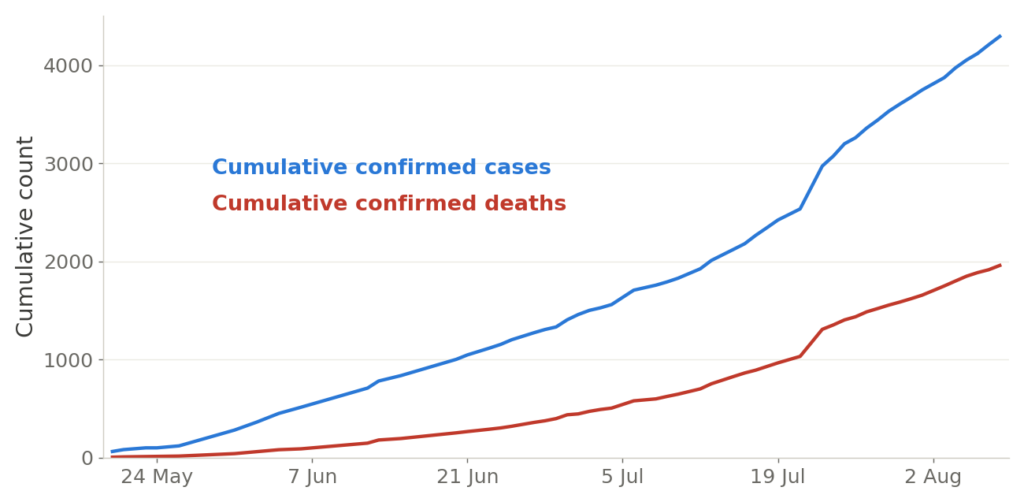
Figure 1. Cumulative confirmed cases and deaths, DRC Ebola outbreak, 20 May – 8 August 2026. Source: DRC situation bulletins (Ministère de la Communication et Médias, @Com_mediasRDC).
Why more tracers will not close the gap
The reason the response is running behind is structural, and it shows in plain arithmetic. Each confirmed case brings a set of contacts who must be found and then watched for up to three weeks. In the last major outbreak in this same region, North Kivu and Ituri in 2018–2020, roughly 150,000 contacts were placed under monitoring for about 3,300 cases, on the order of forty-five contacts for every case, and even that was acknowledged to be an undercount where insecurity kept teams out. At that ratio, a hundred new cases in a day is some 4,500 people to trace and follow; a thousand a day is 45,000. The caseload can multiply from week to week; a trained tracing workforce cannot. So the share of infections arising from transmission chains no one is watching climbs as the outbreak grows, which is what the figure of more than 80% off-list now reflects. This limit is not new. In the 2014–2015 West African epidemic, modeling by Wong, Cooney and Bar-Yam found that once contact information is limited, tracing alone can no longer contain transmission and detection must move to the community level.
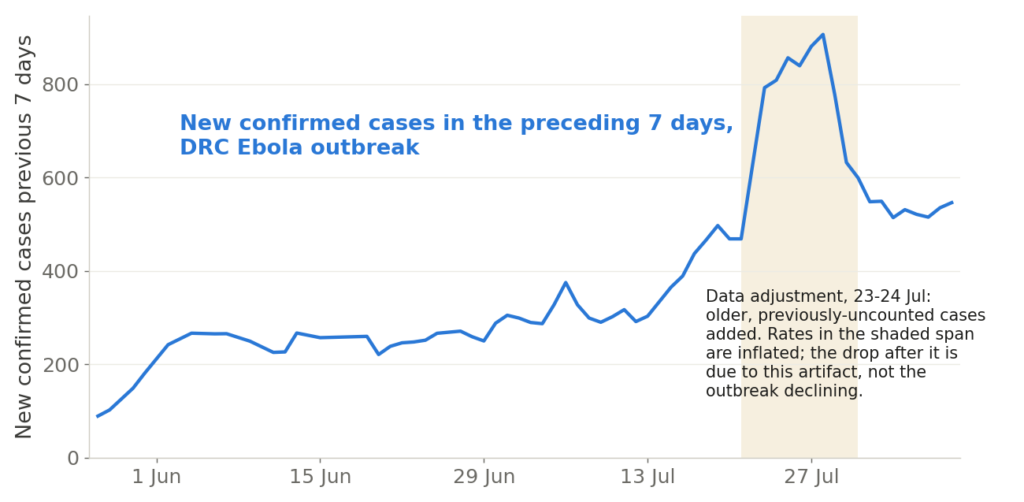
Figure 2. New confirmed cases in the preceding seven days (rolling), each bulletin’s cases distributed evenly across the days since the previous bulletin. See the note on the figure: the peak is inflated by a reported data adjustment that added earlier cases. New cases run near 80 a day, more than double the June rate. Source: DRC situation bulletins (Ministère de la Communication et Médias, @Com_mediasRDC).
The setting works against the method before the arithmetic is even reached. Contact tracing is hard in rural areas and dramatically harder in urban ones, where markets, public transport, high-density housing and street encounters produce transmission that cannot be traced at all. This outbreak took hold not in a settled rural landscape but in the mining country of Ituri, among a mobile artisanal-gold workforce circulating between extraction sites, provincial towns and home villages, and amid one of the world’s largest displacement crises, with more than 900,000 people uprooted by conflict and many of them in camps. Where populations are this mobile and this displaced, the stable, knowable social world that contact tracing assumes does not exist: a person’s contacts are scattered across sites they have passed through and may already have left. The outbreak has now reached Kisangani, a city of well over a million, which adds density and anonymity. Who are the contacts of a feverish person who spent the day in crowded markets, shared taxis and packed streets among strangers? There is no list to be made. Community-based monitoring localizes detection to wherever people actually are, a mining settlement, a displacement camp, a city quarter, and asks each to watch for illness among its own. It holds up across exactly the conditions where tracing is not possible.
The alternative that works: community-based monitoring
At bottom, community-based monitoring is a door-to-door process. Someone reaches each household regularly—typically daily—to ask after illness and check for fever with an infrared forehead thermometer, and to act at once on what they find. That is the plain description of how cases are caught before they spread. The door-to-door form is thoroughly familiar in wealthy countries, where canvassers, religious visitors and census-takers all call at homes as a matter of course; what is unfamiliar is doing so for health. The form is long accepted. Only the purpose is new.
Reaching people at home is what makes detection early, and early is the whole point, because early detection is what stops transmission. Isolating someone at the first fever breaks the chain before it forms. Waiting for the sick to arrive at a hospital catches them only after they have already exposed others, and as this outbreak shows, many never arrive at all.
The form also works because of who is at the door. The monitors are the community’s own: neighbors, members of congregations, local associations, not officials arriving from outside. That is what carries the trust on which early reporting and voluntary isolation depend, and it is what an external tracing operation, however well resourced, cannot manufacture. Where responders have been met with suspicion and at times with violence, as in this outbreak, monitoring carried by trusted local networks is the difference between a household that reports illness and one that hides it. This has a further consequence under conflict: because the monitors are already inside each community and watch only their own, the model needs no teams moving across front lines and no outsiders under armed escort. It is set up locally within each controlled space rather than sent in from elsewhere, so it degrades gracefully where an outsider-run response cannot function at all, and it lowers what the response must obtain from the parties to the conflict—often only that a community be permitted to watch and protect its own sick. This is why the conflict is less of an obstacle to monitoring than it first appears, and it is the argument developed in the companion note on the conflict (A1).
In 2014–2015 it was community-based response, not tracing alone, that drove the decline in Liberia and Sierra Leone. NECSI modeling found that community-level screening reaching roughly 40% compliance was sufficient to halt transmission, consistent with the observed case decline in Liberia after mid-September 2014. In the DRC’s own 2018–2020 outbreak, strengthened community-based surveillance raised the community share of local alerts from 47% to 69% where it was invested in. The current response is already training more than 21,000 community health workers. What is missing is not resources but the commitment to make community-based monitoring the primary detection layer rather than an adjunct to tracing.
It is also the less costly course, because it does not take on the escalating cost that tracing incurs as cases multiply, and its logistics are simpler: regular walking routes through a community become the pattern of case identification.
Detection is bounded by spread between communities
Detection of any kind is undercut if new communities are seeded faster than existing ones are cleared. Each newly infected community is a fresh area to cover from scratch, so an unbounded outbreak expands the monitoring footprint without limit, and the same holds for tracing: a single traveler does not add one link to a chain already being followed, but opens a whole new front. When Ebola reached Mali in 2014, one imported case in Bamako left 332 contacts and nearly 600 people under surveillance, a second response demanded by one person’s journey. This outbreak has taken that path repeatedly, from 34 health zones in three provinces in late June to 37 of the country’s 104 by 8 July and five provinces by 12 July, including the Kisangani cases traced back along a known chain to the outbreak’s core. Community monitoring converges only on ground that is no longer expanding beneath it. Control of movement between communities is therefore a supporting component of this strategy rather than a separate track, and is treated in the companion note.
Recommendations
- Reclassify community-based monitoring as the primary detection strategy in the DRC response, with contact tracing retained only where it still yields.
- Empower community members as monitors, with clear authority and support to detect, isolate and refer, rather than as auxiliaries to tracing.
- Adopt community-participation coverage (target >40%) as the headline operational metric, replacing contact-follow-up percentage, which no longer reflects where transmission is occurring.
- Stand up movement control between communities and around displacement settings, beginning with feasible measures and improving them continuously, so that the monitoring footprint stops expanding. See the companion note.
- Communicate the shift in trust-building terms to communities and partners, to avoid the politicization that fueled resistance and attacks on responders in past outbreaks.
Footnote
[1] WHO Director-General, opening remarks at the media briefing, 16 July 2026—”more than 80% of new cases are being detected outside known contact lists, showing that transmission chains are still being missed,” and “about two-thirds of deaths are occurring in communities, among people who never receive care in a health facility.” https://www.who.int/news-room/speeches/item/who-director-general-s-opening-remarks-at-the-media-briefing—16-july-2026
Additional References
Wong V, Cooney D, Bar-Yam Y. Beyond Contact Tracing: Community-Based Early Detection for Ebola Response. PLOS Currents Outbreaks, 2016 (19 May); New England Complex Systems Institute Report 2016-03-01. arXiv:1505.07020 (https://arxiv.org/abs/1505.07020). https://currents.plos.org/outbreaks/article/beyond-contact-tracing-community-based-early-detection-for-ebola-response/
Bar-Yam Y. How Community Response Stopped Ebola. New England Complex Systems Institute, 11 July 2016. https://necsi.edu/how-community-response-stopped-ebola
CDC. Ebola Virus Disease Outbreak—Democratic Republic of the Congo, August 2018–November 2019. MMWR 2019;68(50). https://www.cdc.gov/mmwr/volumes/68/wr/mm6850a3.htm [~150,000 contacts monitored for ~3,300 cases]
CDC. Early Identification and Prevention of the Spread of Ebola in High-Risk African Countries. MMWR Suppl 2016;65(3). https://www.cdc.gov/mmwr/volumes/65/su/su6503a4.htm [Mali importations; 332 contacts of the second case]
O’Keeffe J, et al. Strengthening community-based surveillance: lessons from the 2018–2020 Ebola outbreak in the Democratic Republic of the Congo. Conflict and Health, 2023. https://link.springer.com/article/10.1186/s13031-023-00536-7 [community share of local alerts, 47.3% to 69.0%]
Social Science in Humanitarian Action Platform (SSHAP). Ituri Ebola Outbreak 2026 (DRC): Summary Overview of Context. 2026. https://www.socialscienceinaction.org/resources/ituri-ebola-outbreak-2026-drc-summary-overview-of-context/ [mining mobility; >900,000 IDPs]
UN News / WHO, DR Congo: Ebola outbreak still expanding, WHO sees signs of stabilization, 21 July 2026. https://news.un.org/en/story/2026/07/1167983 [spread to Tshopo province—five imported cases in Kisangani, no secondary cases yet; five affected provinces]
WHO, Mali case, Ebola imported from Guinea, 10 November 2014 (https://reliefweb.int/report/mali/who-ebola-situation-assessment-mali-case-ebola-imported-guinea-10-november-2014);
UN News, Efforts by UN health agency under way to step up Ebola response in Mali, November 2014 (https://news.un.org/en/story/2014/11/483982). [Bamako importation; ~600 people placed under surveillance—the 332 traced contacts are in the CDC MMWR item above]
The response set
Five component notes that each stand alone and together form one strategy, fronted by the overview (read the overview first):
- A0 — Overview
- A1 — Stopping the violence
- A2 — Community-based monitoring — this note
- A3 — Movement control
- A4 — Resources to the ground
- A5 — Information / countering disinformation
A3 — Bounding the outbreak: controlling movement inside the DRC
Abstract
In June the DRC Government announced that anyone from an affected area must wait 21 days before travelling further, at home or abroad. That is the right measure—but the order signed the same day, which carries the legal force, is far narrower: it bars travel only for identified contacts of a known case, keeps returning responders from leaving the country while letting them move freely within it, and for everyone else addresses travel abroad alone. So the announced measure has no enforceable form, and most people leaving the outbreak zone face no domestic restriction. That gap matters more than the international one, because the outbreak has spread by exactly this route—three provinces became five, and 37 of 104 health zones, by mid-July. Movement control is not a wall against the sick; it holds the outbreak to a size finite capacity can defeat, and lets unaffected places turn their resources toward those that are suffering. The record points one way: control holds where the community carries it and is provisioned to do so.
What the order does, and the gap it leaves
Movement control is a set of measures, each cutting travel or its risk: discouraging unnecessary movement, checkpoints between communities and health zones with local enforcement, and—for the essential travel that can be planned, such as work rotations and resupply—a period of quarantine before departure. Genuine emergencies are the exception and need their own handling: escorted, tested, and isolated transport rather than a 21-day wait. Isolation in transit is not strictly necessary in principle—a traveler still in the incubation period is not yet infectious—but the stakes make it advisable.
The DRC took the key step and stated the principle without qualification: on 24 June 2026, after a physician returning from Ituri was found on arrival in France to have Ebola, it announced that anyone from an affected area must observe 21 days before travelling further, at home or abroad—the principle is exactly right, and to the country’s credit. But the order signed that day is narrower, and sets three rules. Identified contacts of a known case may not travel at all for 21 days—the right restriction. Returning health workers and responders are barred only from leaving the country, and move freely within it. Everyone else who has been in an affected province is covered by a single provision that addresses travel abroad alone: they may fly out after 21 days outside the province, with no say on where those days are spent and no restriction on movement inside the country.
So the announced measure does not exist in enforceable form: a person may leave Bunia for Kisangani the same day and, once 21 days have accumulated anywhere outside Ituri, fly abroad. The case that prompted the order runs straight through the gap—the physician left Ituri, spent three days in Kinshasa, and boarded a flight to Paris almost asymptomatic but for headaches; he reported on arrival, which is why it was contained. And a waiting period is not a quarantine: 21 days spent moving freely lets the virus travel with the person, seeding the very communities the rule was meant to protect. Real quarantine means isolation through the incubation period, and is far better done at the origin, which stops transmission during the journey and needs only a few facilities where the cases already are. None of this requires new legislation—the existing order already lets the health authority add measures and names the provincial authorities and response teams to apply them. What is missing is the instruction—and the facilities and support to carry it out.
Spread between communities is a lever of its own
An outbreak spreads where people go. This one began in the mining country of Ituri and did not stay: three provinces became five by mid-July, and a known transmission chain carried it to Kisangani, a city of over a million far to the west. Every step is the same event at a larger scale—infection carried by a person from a place where it is present to one where it is not. This spread is usually underestimated because it is folded into local transmission, but on its own it can be decisive: an outbreak that jumps from community to community outruns whatever is chasing it, under any detection method. For community monitoring, each newly seeded community is a fresh area to cover from scratch. For contact tracing, a single traveler does not add one link to a chain already being followed—it opens a whole new front. When Ebola reached Mali in 2014, one imported case in Bamako left 332 contacts and nearly 600 people under surveillance. Allow travel without limit and the response is undercut whichever method it rests on.
Why bounding makes suppression possible
Control movement and you bound the outbreak, and a bounded outbreak can be solved: hold it in place, then drive transmission to zero on ground that is no longer expanding beneath you. Against this stands a seductive argument—that if transmission can be pushed down you do not need control, and if it cannot, control will not save you. It fails on cost. Forcing an outbreak into decline everywhere is exorbitant, but doing it in a limited area over a limited time is often possible, and that is what movement control buys. It is the firebreak that lets local suppression be the water: the break alone extinguishes nothing, but it confines the fire to ground the water can cover. Neither wins alone; together they win, because the first makes the second enough. This is why control belongs at every scale—between health zones and towns, and around displacement settlements—not only at national borders: quarantine is not for shutting people away but for bringing the strength of the whole to bear on the part in need.
What makes internal movement control work
Three requirements come out of the West African record, offered as design guidance rather than as verdicts on the cases they come from.
The community carries it. Communities have run their own boundaries in hard settings. Lugbu Chiefdom in Sierra Leone staffed thirteen checkpoints, required every visitor and returnee to report, held or excluded anyone away more than three days, and stayed free of the disease while its neighbours were not—with visibly impartial enforcement (the Paramount Chief fined himself for failing to report his own nephew’s illness). A roster, a reporting rule, a place to hold arrivals, and rules that bind those who make them.
Where control is imposed, hand it over. The 2014 cordon of West Point in Monrovia, usually cited against movement control, is better read as the case for the handover: imposed abruptly, it provoked unrest and was lifted after ten days, and in exchange the community took on identifying and removing the sick, quarantining households, and tracing contacts. The response there became community-led and recorded its last case in December, ahead of the rest of the city. What failed was the imposition; what worked was what the community did once it held the responsibility—in the densest urban setting in the record.
Provision it, and aim it at transmission. People leave a sealed area to find food; over a million under quarantine in Sierra Leone needed food aid by December 2014. Provisioning is not an add-on but part of what makes control hold, and it belongs in the response budget. And the aim matters as much: where local authority was turned to concealing cases instead of interrupting transmission, as at Mathiane, the outcome was worse than no measure at all.
Screening at a boundary is not a substitute for holding
Screening at a boundary helps only so far. An Ebola test detects the virus only once a person is symptomatic or nearly so, so a traveler still incubating passes it and carries the infection through. The West African record is stark: exit screening of roughly 300,000 travellers detected essentially no true cases, and every genuine importation was caught after arrival, not at a border. The June case fits—the physician boarded with headaches, an early symptom that sits below the fever threshold screening is built to catch. Holding people across the incubation period, not a test at the gate, is what closes the route. This is also why the argument here is not one for closing international borders, which WHO advises against and which cuts the flow of aid and personnel the response depends on. Source containment yields more than border control; the measures that matter are internal.
Start with what is feasible; improve continuously
Movement control takes effort and will never be perfect, least of all amid conflict—but that is no reason to wait. The two levers reinforce each other: better movement control means fewer infected people reach new communities, keeping the monitoring footprint small; better local monitoring means fewer infected people travel, so even imperfect checkpoints can stop enough of them. The mistake that has frozen pandemic-control thinking is to treat travel restriction as worthless because it cannot be made absolute; imperfect control still slows spread and buys time. Begin with what each community and health zone can do now—a campaign against needless travel, a workable checkpoint, a quarantine protocol with a real isolation site and provisioning—and strengthen it week over week. Uganda’s near-containment, about 20 cases now in its 42-day countdown, shows what disciplined movement control achieves with strong local detection; the DRC needs the same, inside its own borders.
Recommendations
- Give the announced domestic rule enforceable form. Under the existing order, with no new legislation: require the 21-day period before movement out of an affected province by people who are not identified contacts, and extend the bar on returning responders to their movement inside the country as well as abroad. Directed to the DRC Ministry of Public Health, Hygiene and Social Welfare, and to local authorities.
- Specify that the 21 days are spent in isolation, not merely outside the province—at dedicated, provisioned sites in the affected provinces, with daily symptom checks by local health teams—for domestic and international travel alike.
- Site quarantine at the origin, not the destination, with a small number of provisioned isolation facilities in the affected provinces.
- Resource quarantine as welfare, not enforcement. Food, income replacement and health access are what make compliance possible, and their cost belongs in the response budget.
- Set up movement monitoring between communities, health zones and displacement camps—run by local authorities where they exist, and with the community’s agreement secured before any restriction is applied.
- Do not rely on testing or screening at boundaries as a substitute for holding travellers across the incubation period.
References
Ministère de la Santé Publique, Hygiène et Prévoyance Sociale (RDC). Arrêté Ministériel N°1250 du 24 juin 2026. Order posted by @Com_mediasRDC, 25 June 2026: https://x.com/Com_mediasRDC/status/2070141956513055226 — full text and translation also in DRC primary sources on movement control, 24 June 2026 (WHN source document).
Ministère de la Communication et Médias (RDC). Communiqué, Kinshasa, 24 juin 2026 [announced 21-day period; physician’s itinerary]. Posted by @Com_mediasRDC, 24 June 2026: https://x.com/Com_mediasRDC/status/2069900411931160681
Ministère de la Santé et de l’Accès aux Soins (France), statement of 24 June 2026 (France 24; AFP) [boarded almost asymptomatic but for headaches; isolated on landing; five passenger contacts]. https://www.france24.com/en/france/20260624-france-confirms-first-ebola-case-in-doctor-returning-from-dr-congo-mission
CDC. Early Identification and Prevention of the Spread of Ebola in High-Risk African Countries. MMWR Suppl 2016;65(3) [Mali; 332 contacts]. https://www.cdc.gov/mmwr/volumes/65/su/su6503a4.htm
Kamara F, Mokuwa GA, Richards P. Keeping Ebola at bay: public authority and ceremonial competence in rural Sierra Leone. Journal of Modern African Studies, 2022; 60(1):65–84 [Lugbu Chiefdom]. https://doi.org/10.1017/S0022278X21000422
Oxfam. Ebola Secrets: what happened when an epidemic hit a village in Sierra Leone? From Poverty to Power (Oxfam) [Mathiane; concealment]. https://frompoverty.oxfam.org.uk/ebola-secrets-what-happened-when-an-epidemic-hit-a-village-in-sierra-leone/
ALNAP / IFRC. Ebola Response in Cities: Learning for Future Public Health Crises. 2017 [West Point: community-led from September 2014; last case December 2014]. https://reliefweb.int/report/liberia/ebola-response-cities-learning-future-public-health-crises
Gostic KM, Kucharski AJ, Lloyd-Smith JO. Effectiveness of traveller screening for emerging pathogens is shaped by epidemiology and natural history of infection. eLife 2015;4:e05564 [exit/border screening misses incubating travellers]. https://elifesciences.org/articles/05564
Otsuki S, Nishiura H. Reduced Risk of Importing Ebola Virus Disease because of Travel Restrictions in 2014: A Retrospective Epidemiological Modeling Study. PLoS ONE 2016;11(9):e0163418. https://journals.plos.org/plosone/article?id=10.1371/journal.pone.0163418
SSHAP. Ituri Ebola Outbreak 2026 (DRC): Summary Overview of Context. Social Science in Humanitarian Action Platform, 10 June 2026 [mining mobility; >900,000 IDPs]. https://www.socialscienceinaction.org/resources/ituri-ebola-outbreak-2026-drc-summary-overview-of-context/
WHO and UN News, DRC Ebola outbreak situation reporting, June–July 2026. https://news.un.org/en/story/2026/07/1167983
The response set
Five component notes that each stand alone and together form one strategy, fronted by the overview (read the overview first):
- A0 — Overview
- A1 — Stopping the violence
- A2 — Community-based monitoring
- A3 — Movement control — this note
- A4 — Resources to the ground
- A5 — Information / countering disinformation
A4 — Getting resources to the ground: Coordinating procurement and logistics
Abstract
The response effort depends on physical things reaching the right hands: thermometers and protective equipment for community monitors (A2), tents and supplies for those in preventive isolation, materials for safe and dignified burials, and the printed material carrying accurate information (A5). This note explains how to get them there. The most important capability is coordination of the action across the whole process: identifying what is needed through interaction with the communities that will use it, obtaining the goods, and delivering them into their hands. Goods may be bought or donated, and transport may be paid, provided at reduced cost, or donated; acquisition, delivery, and use have to be well coordinated and communicated. Much of what is needed can be bought in local and regional markets, which is faster and often lower cost. For what must be imported, a global humanitarian delivery system is already operating for this outbreak, and its main services are free to organizations that register for them. Completing the delivery from regional hubs to the communities may also benefit from merchant networks that trade across the conflict lines (A1). We invite people who can communicate and coordinate with parties along the entire process.
What is needed
The focus of this response is prevention: finding people with early symptoms, isolating them before they can infect others, and protecting everyone involved. Treatment of those whose illness progresses is the work of others and is not addressed here. The supplies of prevention are modest and mostly inexpensive.
For monitoring (A2): infrared forehead thermometers, personal protective equipment (PPE), gloves, soap, and chlorine for disinfection. For isolation: tents or other separate housing, set up and run by the community. The point to understand is that most of the people isolated are not sick with Ebola: they have early symptoms, a fever that could be any of several illnesses, and are isolated as a precaution. They must therefore be housed apart, and apart from one another, so that a person who does not have Ebola does not catch it in isolation; they must be cared for safely by people in PPE; and they and their families need food and support. For safe and dignified burials: burial bags, disinfectant, and PPE for those who prepare the dead. The bags are not ordinary body bags: in many places what is needed is a specially adapted burial bag with a viewing window, so that the family can see the deceased as a substitute for the touching and washing that cannot be done safely. Whether and where this applies has to be confirmed with each community and its religious authorities, and the right designs sourced accordingly. For communication: the printed material that carries accurate information (A5). The protective kits described in A1 bundle these into packages with information so they are easier to use.
Who needs what, where, and in what quantity is not decided from outside. Requests come from communities and from the people working on planning the response with them, through the same relationships and listening that A5 describes, and the job of this front is to help fill those requests.
Coordination across the process
Coordinating supplies to communities is a chain of communication tasks: learning what is needed, finding the goods, whether bought or donated, identifying the delivery process to the local area, and the chain that puts them into the hands of the people who will use them. These tasks are linked: how they are packed affects how they can move; how they will move affects where they can go; who they are for, and where, affects everything. What is required is communication and coordination, first among the people who are doing the coordination, so that what, how, where, and to whom are worked out together.
This is what the beginning of the process actually looks like. Hundreds of thousands of respirators donated in Canada, for example, roughly two and a half tonnes occupying some 30 to 55 cubic meters, are pending transport plans and specific recipients, including coordination with colleagues in Uganda and known local community leaders in the DRC. Working directly with community partners, NGOs, humanitarians, and national or international response actors, mobilizing donations and partnerships with manufacturers, institutions, and humanitarian organizations, and supporting reliable delivery to frontline teams. Just as importantly, the WHN-ECAN (Ebola Collaborative Action Network) project pairs equipment with practical guidance on appropriate PPE selection, fit testing, donning and doffing, infection prevention and control, and stock management, so that support strengthens local capacity rather than serving as a one-time shipment.
The delivery system that already exists, and how to use it
For goods that must be imported, it is essential to know that a global humanitarian logistics system is already running for this outbreak. Using it is far less costly and faster than building anything parallel, and several of its services are free.
The center of it is the Logistics Cluster, the United Nations’ coordination mechanism for humanitarian transport, led by the World Food Programme, the UN agency that moves food aid and is the largest humanitarian logistics operator in the world. When a major emergency is declared, the Logistics Cluster organizes shared transport and storage for all responding organizations, not only UN agencies. In this response it has already moved more than a thousand tonnes of partner organizations’ cargo free of charge, operates shared warehouses in the region with more being established in Ituri, the outbreak’s core province, and maintains staging areas in Uganda and Rwanda. Any legitimate responding organization can register as a partner and submit requests for transport and storage.
Two other channels can complement it, one built for speed and one for scale. The first is the humanitarian and faith-based pathway, suited to rapid first deployment. It rests on the presence, trust, facilities, personnel, and established relationships of religious and faith-based organizations already operating in Africa, and particularly in the DRC. Rather than build its own distribution infrastructure, a network of participating organizations could help identify a credible receiving institution, confirm what health workers actually need, serve as consignee or local implementation partner where appropriate, handle customs and administrative arrangements, and help ensure the PPE reaches the identified facilities and frontline teams. Faith-based organizations are particularly important here, because many hold longstanding relationships with hospitals, clinics, community leaders, and remote communities. That makes a first shipment not simply a donation of respirators but a practical test of an ECAN principle: international resources delivered through trusted local structures and according to locally identified needs.
The second is a governmental and diplomatic pathway, which could be developed through cooperation between Canada and Uganda (for example Global Affairs Canada, the Government of Uganda, and the relevant DRC authorities) together with local receiving partners. Uganda matters here because Entebbe is already functioning as a major international staging hub for the Ebola response. PPE originating in Canada could be consolidated and transported to Entebbe, with governmental and diplomatic engagement helping resolve documentation, import and transit requirements, institutional contacts, and coordination with the humanitarian response. From Entebbe, cargo could enter the established humanitarian corridor to Bunia by air or road. This route could be especially important for larger, later shipments, because it pairs Canada’s equipment and institutional support with Uganda’s position as the principal regional gateway to eastern DRC.
The route itself is fixed by geography and aircraft. There are no direct air services from most of the world into the outbreak area, so cargo flies on large aircraft to Entebbe airport in Uganda, the designated staging hub, and continues on smaller aircraft and by road to Bunia, the main town of Ituri, whose airfield cannot take large planes. Several carriers fly this shuttle daily. The onward leg is about 350 kilometers by air, roughly an hour’s flight, but about 900 kilometers by road, which must run north through Uganda to the Mahagi border crossing and then south to Bunia, typically two to four days for cargo including border clearance, depending on conditions and security. Alongside this, the UN operates a network of humanitarian depots (UNHRD, the UN Humanitarian Response Depot network, with hubs including Dubai) that store partner organizations’ emergency stock free of charge and dispatch it within a day or two; consolidated relief flights from Dubai to Entebbe are already running for this outbreak, and space on them can be requested.
The three pathways should therefore be viewed as a progressive logistics strategy: use the trusted humanitarian/faith-based network to demonstrate that WHN-ECAN can mobilize an initial shipment rapidly; develop the Canada–Uganda governmental route to provide diplomatic and institutional support and enable larger shipments; and progressively integrate it into the WFP-led Logistics Cluster for sustained, scalable deliveries. ECAN’s role would not be to become a freight operator. Its value would be in identifying verified needs, mobilizing PPE and donors, connecting international resources with credible local recipients, coordinating the appropriate delivery pathway, and verifying that supplies reach frontline health workers. In this way, the first several thousand N95 respirators become both immediate protection for health workers and a pilot for a repeatable international-to-local humanitarian supply chain.
The last stretch: from the hub to the community
The humanitarian system delivers to towns and warehouses. The need is in mining settlements, displacement camps, and villages beyond checkpoints and front lines that outside vehicles cannot reach reliably or safely. Goods already move there every day, carried by the region’s own merchants, whose routes cross all factions’ territory because commerce is the one activity every side permits. Merchants may therefore be helpful in final delivery to the communities they already serve, an approach A1 describes for the protective kit, with contactless handover as the standard precaution. Religious and other community organizations may also be able to carry some goods for final delivery.
Who receives it: the destination
A consignment must have its recipient, a person or group who asked for the goods, who will take custody of them and will distribute them for use: a community committee, a parish or mosque, a health worker, the group organizing the monitoring (A2), a merchants’ or women’s association. Identifying the recipient and agreeing on their role is part of planning every delivery, settled before the goods are sent.
What we are looking for
This front works in parallel with the others. We invite people who can communicate and coordinate with parties throughout the entire process: with communities and response planners, to know what is needed; with suppliers and donors, to obtain it; with humanitarian services and carriers, to move it; and with recipients, to complete and confirm delivery.
Recommendations
- Coordinate what, how, where, and to whom. The tasks of learning what is needed, obtaining the goods, moving them, and delivering them are developed together, with the people doing each part keeping the others informed as the process unfolds.
- Fill requests according to needs. The list of what is needed is stated by communities and the people planning the response, through the relationships of A5, and defines what is sourced.
- Where possible, buy in the local region. Local and regional purchase is faster, and avoids the import chain; import only what cannot be had nearer.
- Use the existing humanitarian system. Register with the Logistics Cluster, request its free transport and storage, use the Entebbe staging route and consolidated flights, and inquire whether an agency with a running pipeline can help fill gaps.
- Check the route’s current conditions before shipping. What papers are needed to pass through Uganda and enter the DRC without duty, arranged before they arrive, and whether dry, covered storage is waiting for them at the destination.
- Consider merchants for final delivery. The region’s merchants already serve the communities the response needs to reach, along routes that cross the conflict lines (A1), and may be helpful in the final delivery, with contactless handover as the standard precaution; religious and other community organizations may also be able to carry some goods.
- Agree the recipient before anything is sent. Every consignment has a named recipient in the community, the person or group who asked for it, who takes custody, distributes as the request described, and keeps a simple record the community can see.
References
Africa CDC and WHO, joint statement calling for urgent community-led action to contain Ebola in the DRC, 6 August 2026. https://www.who.int/news/item/06-08-2026-africa-cdc-and-who-call-for-urgent–community-led-action-to-contain-ebola-in-the-drc
How humanitarian logistics is supporting DRC’s Ebola response (corridors, carriers, Logistics Cluster free services). LogUpdate Africa, 2026. https://www.logupdateafrica.com/logistics/how-humanitarian-logistics-is-supporting-drcs-ebola-response-1360048
Uganda boosts regional Ebola logistics (Entebbe staging hub). LogUpdate Africa, 2026. https://www.logupdateafrica.com/amp/logistics/uganda-boosts-regional-ebola-logistics-1359649
Dubai Humanitarian, third consolidated Ebola airlift to Entebbe (76.2 tonnes, transport donated). LogUpdate Africa, 2026. https://www.logupdateafrica.com/amp/air-cargo/dxbh-sends-76-tonnes-of-aid-for-drc-ebola-response-1359603
UNHRD (UN Humanitarian Response Depot network), Our Services. https://unhrd.org/our-services
Logistics Cluster, DRC activities (free partner transport, shared storage). https://logcluster.org/en/activities/drc
DRC — Ebola Response Concept of Operations, May 2026. ReliefWeb. https://reliefweb.int/report/democratic-republic-congo/drc-ebola-response-concept-operations-may-2026
SSHAP. Ituri Ebola Outbreak 2026 (DRC): Summary Overview of Context. Social Science in Humanitarian Action Platform, 10 June 2026. https://www.socialscienceinaction.org/resources/ituri-ebola-outbreak-2026-drc-summary-overview-of-context/
Canadian Red Cross. An innovative solution to respond to Ebola (burial bag redesigned with a transparent viewing window so the family can see the deceased). 2019. https://www.redcross.ca/blog/2019/8/at-the-social-innovation-challenge-an-innovative-solution-to-respond-to-ebola
IFRC. Safe and Dignified Burial: An Implementation Guide for Field Managers. https://www.ifrc.org/document/safe-and-dignified-burial-implementation-guide-field-managers
The response set
Five component notes that each stand alone and together form one strategy, fronted by the overview (read the overview first):
- A0 — Overview
- A1 — Stopping the violence
- A2 — Community-based monitoring
- A3 — Movement control
- A4 — Resources to the ground — this note
- A5 — Build trust and deliver clear information
A5 — Building trust: delivering clear information through the voices and channels communities already trust
Abstract
Behind the plainest facts of this outbreak are communities, families, and individuals making decisions in fear and in grief or in anger and disbelief. Two thirds of those who die are dying at home, among people who chose to care for them there. Burial teams have had bodies taken back; responders have been attacked and taken hostage. The distrust behind these acts was earned: in the 2018 to 2020 epidemic in this same region, the response too often arrived as a convoy of armored vehicles descending on a village to take a sick person away, and it was carried to its end by a vaccine. This outbreak is a different species of the virus, with no licensed vaccine, and there is no rescue this time for a response the communities do not carry themselves. It is unfolding in mining settlements that are not really villages and among displaced communities that have very little, in a region of vast wealth extracted around people who see none of it, where aggression is learned because it is what works and many of those who do harm are themselves among the harmed. Communication in this space must be credible, concrete, and carried by people with standing. The center of this front is therefore partnership with the leaders communities already follow, often religious leaders, who remain present where much is broken; the first partners for this work are known, and building community communication with them has been done before, including in our own experience. The work is to reach people through those they already know, to listen before speaking, to answer through trusted voices in their own languages and channels, to share the stories of the West African communities that ended the largest epidemic in history, told community to community, and to carry the knowledge that protects families: how to recognize the disease, how a community watches over its own (A2), and how to bury and mourn the dead with both safety and honor. None of this waits for the other fronts; trust grows from the work itself. We are looking for people who want to learn the local context and communicate within it, and for people who can make accurate information easy to find, read, hear, and act on.
The problem is trust, and the distrust was earned
The events that show the absence of trust are clear, and each one, looked at closely, is a human decision. A family that keeps a sick person at home is protecting someone it loves from a response it fears. A community that takes a body back from a burial team is refusing to let someone it loves be carried away by strangers, buried unseen and unblessed. Two thirds of deaths are happening at home, among people who never reached care; four in five new infections are being found outside the known chains of transmission. None of this is ignorance waiting to be corrected. It is fear and love acting on experience, and where it stands, monitoring fails, isolation fails, and every front of the response fails with them.
The experience it acts on is recent. In the 2018 to 2020 epidemic in this same region, the response too often arrived as a convoy of armored vehicles descending on a village to take a sick person away. It is not hard to imagine how that looked to the people watching. A quarter of those surveyed in Beni and Butembo at the time believed Ebola was not real, the belief went together with distrust of the institutions responding, and the response met the same violence it is meeting now. That response nonetheless reached its end, because it had a vaccine to carry it, and even so it was a near thing. This outbreak is a different species of the virus, with no licensed vaccine. There is no rescue this time for a response the communities do not carry themselves.
The ground must also be seen as it is. This outbreak runs through mining settlements that are not really villages, encampments of a workforce circulating around the gold, and through displacement camps where people have very little, in a region where enormous wealth is extracted around people who see none of it. In such a place aggression is learned, because it is what works, and many of those who do harm are themselves among the harmed. The crowd that wrests a body from a burial team may be a grieving family or an organized gang; both things may be true, and a response that sees only one of them will fail. Compassion that ignores the hardness and hardness that ignores the suffering cannot get through. What this front must build is neither softness nor force but credibility: the standing that comes from arriving through trusted people, saying true and useful things, and being borne out by what follows.
The solution has been demonstrated, and its story can be shared
The West African epidemic of 2014 and 2015, the largest on record, was ended above all by communities caring for their own. Chiefs organized their villages to watch over the sick; imams and pastors remade burial rites so the dead could be honored without harming the living; neighbors took responsibility for neighbors. It was this, more than any outside intervention, that drove the decline in Liberia, Sierra Leone and Guinea. Those communities had something this response lacks: a decade of peace, and the rebuilt community life that peace makes possible. The DRC’s outbreak sits inside an active war, and what safety can be secured, zone by zone, is the work of A1.
But West Africa left something behind for the communities facing Ebola now: its example, and its people. The survivors, chiefs, imams and pastors who lived that response can share what happened with the communities of Ituri and North Kivu, not as instruction from outside but as one community’s experience offered to another, joined with the stories already being lived and gathered in this outbreak. Stories like these carry knowledge the way people actually receive it, from someone who has stood where they stand: how the sick were found, how burials were made safe and still sacred, how it ended. And they carry the one message this response most needs believed: communities have done this, and can do it again. Africa CDC and WHO have called for urgent community-led action; it begins with communities hearing, from other communities, that it is possible.
Relationships, then inquiry
Trust begins with who arrives, and how. The response reaches each community through people it already knows: its religious communities, the doctors, nurses and responders of earlier outbreaks, its associations, its relatives abroad. A conversation opened by someone already known is a different conversation.
And the partners for this are known; this is not a hope. Religious leaders are present in communities, mining camps and displacement sites. When administration and services are gone, their standing survives where the state’s does not, and they have carried exactly this work before: in West Africa it was imams and pastors who remade burial rites and brought the response to their own congregations. Our own experience includes working with religious leaders to build community communication about the challenges and the response in DRC. We have partners to talk with in DRC and Uganda, community leaders and those who have led outbreak responses on the ground across countries and years, and it is there that this front begins.
And it begins by listening. Every community has its own beliefs, worries and questions about this disease, changing week to week as events feed them, and a response that arrives cannot be guessing. In the last outbreak, local teams gathered people’s questions and rumors through radio stations and face-to-face conversation, and answered them on the air, in people’s own languages. Listening of that kind can begin in any locality where there is a partner who knows and listens to the community and we can learn from. It should also go deeper than rumors: inviting people to tell what has happened to them, what they did, what they needed and did not receive. Being heard is a form of respect, and it is the difference between having a voice and being an audience. What a community needs to hear is defined by the community itself. A working set of questions for inviting such accounts, from people who carried past responses as well as those living this one, is given in the addendum to this note.
Trusted delivery, not head-on rebuttal
When people believe the outbreak profits its responders, an official denial does not reassure them; it confirms what they suspected, and repeats the rumor besides. What reaches people is a voice they already trust: a pastor or imam speaking to his own congregation, a radio host they have woken to for years, a healer, a teacher, a neighbor who survived the disease and came home. The ways to reach people are known: community radio above all, which arrives where nothing else does; the WhatsApp threads along which rumors themselves travel; churches and mosques; markets and schools; and survivors, whose lives are the most credible answer to the claim that no one comes back. Facebook and TikTok have become part of daily life in the region in recent years and carry both rumor and news; each plays its own part in how people learn and talk, and communication should meet each one as it is actually used. With every trusted voice there is important work to share: participating in preparing accurate content in the right language, in a form a radio host can read aloud and a congregation can act on, with the West African stories at its heart. And in this place words are judged by what follows them: what is said must be concrete and useful, and what is promised must be kept.
The knowledge to carry: finding the sick, and burying the dead safely
What any one community needs first is learned by asking. What can be said in advance is what the knowledge is for: protecting the people one loves. A family needs to know what the disease looks like and how it spreads, and how to care for someone while protecting the one who cares. A community needs to know how to watch over its own: who goes from door to door, what they look for, whom they tell, and what happens next, the monitoring described in A2, carried out not by officials but by neighbors. And every family needs an honest answer to the question it will ask first: what happens to someone who is taken for treatment, because the fear that a person will vanish into a treatment center is often what keeps the sick at home.
The dead must be part of this knowledge, because love for the dead is where this disease is most cruel. The body of a person who has died of Ebola is at its most infectious just when the family most needs to wash, hold, and mourn. A single funeral of a traditional healer in Sierra Leone was traced to 365 deaths; safe and dignified burials in West Africa are estimated to have prevented thousands of infections, and did so again in the eastern DRC in 2018 and 2019. West Africa also showed what makes safe burial acceptable: not enforcement, but a real accommodation of grief, worked out with the religious authorities themselves, imams and pastors bringing safe rites to their own congregations, ceremonies negotiated rather than overridden. Where prayers are said, the body seen at a safe distance, family members present in protective clothing, the grave marked and visitable, families ask for safe burial. Where it has meant strangers in suits taking a body away to be buried unseen, deaths are hidden. Communities should know, before a death and from their own religious authorities, what a safe and dignified burial is and what they have the right to ask for, so that when grief comes, the request is the family’s own.
Built together with every other front
Trust is not a stage to complete before the rest of the response may begin, and it cannot be; it is built by the work itself, in every act of it. The neighbor at the door (A2) is this front’s message in person. Supplies that arrive because a community asked for them (A4) speak louder than any broadcast. A burial that honors the dead persuades more than a campaign. Each visit that goes well makes it easier for the next family to speak up. Even the violence (A1) is touched by this work: a response carried by a community’s own people, bringing nothing across a front line but knowledge and simple tools, is harder for anyone to cast as an enemy, and whether the protective kit described there is welcomed or feared depends on how it is named and offered, which is this front’s care. The fronts grow together, each making the others possible, and this one runs through all of them.
We are looking for people who want to learn the local context and communicate with the people in it. We also need people who know the local context and can share it: Congolese communicators at home and in the diaspora, and people with standing in faith networks, community radio, and local associations. While French is the official and written language, daily life in the affected provinces runs in Congolese Swahili and in the local languages of Ituri, North Kivu, and Tshopo, and communication is needed in all of these. And we are looking for people who can make accurate information easy to find, read, hear, and act on: translators, writers, designers, and audio producers.The addendum to this note gives a working set of questions for inviting the experiences of those who have worked in past outbreaks and those living through this one.
Recommendations
- Arrive through people already known in the area/community. Build relationships with community members and leaders through the connections that already exist: religious and political leaders present across communities, mining camps and displacement sites, the medical and response people of earlier outbreaks, local associations, and family ties abroad. Some partners are already known.
- Inquire before speaking, in every locality. Gather people’s questions, rumors, and experiences through partners already present, radio stations, faith networks, local associations, and let what people say define what is communicated.
- Answer through the voices people already trust. Support local political and religious leaders, community radio, survivor networks, and the social networks active in the DRC with accurate material in their own languages, rather than running campaigns from outside.
- Open the sharing of the West African story. Create occasions for the people who lived the 2014 to 2015 response to share their experience with the communities facing the disease now, joined with the stories being gathered in this outbreak; a story from someone who has stood where the listener stands persuades where instruction cannot.
- Learn the part the new social media play. Facebook and TikTok have entered daily life in the region in recent years and carry both rumor and news; understand how each is actually used, and by whom, and meet people there accordingly.
- Answer false claims from within. Take what listening surfaces and help to answer it directly, through the trusted local voice and channel, in local terms; head-on institutional rebuttal repeats the claim and deepens the suspicion.
- Carry the knowledge that protects families. How to recognize the disease and how a community watches over its own (A2); and, before grief arrives, what a safe and dignified burial is and what families have the right to ask for, accommodated respectfully with religious authorities, so that requests for safe burial come from families themselves.
- Let every front carry this one, and this one every front. Trust is built by the conduct of the whole response; follow what listening reveals, the reach of trusted voices, requests for safe burial, and whether illness is reported or hidden, together with the participation in community monitoring (A2).
References
Africa CDC and WHO, joint statement calling for urgent community-led action to contain Ebola in the DRC, 6 August 2026. https://www.who.int/news/item/06-08-2026-africa-cdc-and-who-call-for-urgent–community-led-action-to-contain-ebola-in-the-drc
WHO Director-General, opening remarks at the media briefing, 16 July 2026. [more than 80% of new infections detected outside known contact lists; about two thirds of deaths occurring in the community] https://www.who.int/news-room/speeches/item/who-director-general-s-opening-remarks-at-the-media-briefing—16-july-2026
Vinck P, Pham PN, Bindu KK, Bedford J, Nilles EJ. Institutional trust and misinformation in the response to the 2018–19 Ebola outbreak in North Kivu, DR Congo: a population-based survey. The Lancet Infectious Diseases 2019;19(5):529–536. https://www.thelancet.com/journals/laninf/article/PIIS1473-3099(19)30063-5/fulltext
Internews. Managing Misinformation in a Humanitarian Context (rumor-tracking learning collection, with DRC Ebola case studies). 2019. https://internews.org/wp-content/uploads/2021/02/Rumor_Tracking_Mods_1-2_Context-Case-Studies.pdf
Radio tackling rumours and misinformation in DRC’s deadliest Ebola outbreak. ReliefWeb, 2019. https://reliefweb.int/report/democratic-republic-congo/radio-tackling-rumours-and-misinformation-drc-s-deadliest-ebola
WHO. Sierra Leone: a traditional healer and a funeral. [365 deaths traced to one funeral] https://www.who.int/news/item/01-09-2015-sierra-leone-a-traditional-healer-and-a-funeral
Tiffany A, et al. Estimating the number of secondary Ebola cases resulting from an unsafe burial and risk factors for transmission during the West Africa Ebola epidemic. PLOS Neglected Tropical Diseases 2017;11(6). [safe and dignified burials estimated to have averted 1,411–10,452 infections] https://journals.plos.org/plosntds/article?id=10.1371/journal.pntd.0005491
Effect of a safe and dignified burial intervention on Ebola virus transmission in the eastern Democratic Republic of the Congo, 2018–19: a propensity score analysis. The Lancet Global Health, 2025. https://www.sciencedirect.com/science/article/pii/S2214109X25002207
WHO. How to conduct safe and dignified burial of a patient who has died from suspected or confirmed Ebola or Marburg virus disease. WHO/EVD/Guidance/Burials/14.2. https://www.who.int/publications/i/item/WHO-EVD-Guidance-Burials-14.2
Anoko JN. Communication with Rebellious Communities during an Outbreak of Ebola Virus Disease in Guinea: An Anthropological Approach. Ebola Response Anthropology Platform, 2014. [a negotiated respectful burial ceremony ended community resistance] https://www.socialscienceinaction.org/resources/communication-with-rebellious-communities-during-an-outbreak-of-ebola-virus-disease-in-guinea-an-anthropological-approach/
Wilkinson A, Parker M, Martineau F, Leach M. Engaging ‘communities’: anthropological insights from the West African Ebola epidemic. Philosophical Transactions of the Royal Society B 2017;372(1721). https://royalsocietypublishing.org/doi/10.1098/rstb.2016.0305
Richards P. Ebola: How a People’s Science Helped End an Epidemic. Zed Books, 2016.
SSHAP. Ituri Ebola Outbreak 2026 (DRC): Summary Overview of Context. Social Science in Humanitarian Action Platform, 10 June 2026. https://www.socialscienceinaction.org/resources/ituri-ebola-outbreak-2026-drc-summary-overview-of-context/
Addendum: a working question set for inviting experience
The accounts this note relies on, from the people who carried the West African and other past responses and from the people living this outbreak now, have to be invited, and how they are invited matters. People respond to a request for a concrete moment, good or bad, not for an abstraction, and the questions below deliberately avoid the word story. This is a working draft, offered for use and improvement.
Shown as a menu; each question asks for a specific moment and what happened:
- Can you remember a specific moment working on an Ebola outbreak when something went well, or badly, that has stuck with you? What happened?
- If you wanted to help someone get ready for the next outbreak, what one moment from your own experience would you tell them about? What happened?
- Was there a moment when getting, or not getting, the right information at the right time changed how things went? What happened?
- (Catch-all) Is there anything else about managing this outbreak that mattered to you? What happened?
About the person, asked last:
- Main role in the response (clinical care / contact tracing and surveillance / burial and infection control / logistics and supply / community engagement / lab and diagnostics / coordination and management / survivor who then worked in the response / other)
- Organisation type (Ministry of Health / international NGO / UN agency / local community organisation / faith-based or private facility / independent / other)
- Which outbreak and where (for example West Africa 2014–16, DRC/Kivu 2018–20, or a smaller local one), and whether the person was a local resident or deployed in
- Response experience before this one (a scale from none before to many times)
- Anything else about your background that would help someone make sense of what you told us (free text)
Every closed field needs an “I’d rather not say” option. Responder communities are small enough that role, outbreak, and location together can identify someone.
The response set
Five component notes that each stand alone and together form one strategy, fronted by the overview (read the overview first):
- A0 — Overview
- A1 — Stopping the violence
- A2 — Community-based monitoring
- A3 — Movement control
- A4 — Resources to the ground
- A5 — Build trust and deliver clear information — this note
Version 1.0 — August 24, 2026 — Initial publication