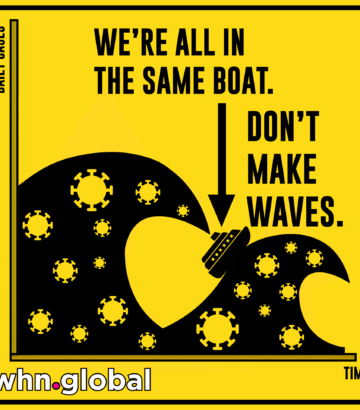
Building bridges: A joint reflection between a COVID-cautious psychology lecturer and a psychology student and aspiring clinical psychologist
The COVID-cautious lecturer (Aspa): I lead a module for the Cognitive Psychology module (second year, undergraduate). This year I would deliver the introductory lecture. I am COVID-cautious, I always wear a mask at work, including when I lecture. In the previous years, I didn’t include anything about COVID-19 in my teaching material. This year I decided to change that. I talked about the effect of COVID-19 on cognitive function, the importance of clean indoor air, the importance of metacognitive reflection to help us reduce cognitive biases and become better psychologists, medical practitioners – better humans. I related all this to UN’s sustainable development goals, and the recent clean indoor air pledge.
As one of the employability leads (i.e. someone that tries to help students think of their employment options in relation to what they are studying), I always like to include optional writing and publishing opportunities for our students. I gave them 3 suggestions: they could write reflexive articles about 1) climate 2) AI and/or 3) COVID-19. Given that semester 1 of the second year is such a difficult semester, I expected that very few students would take up the opportunity, and that no one would want to write about COVID-19.
The only person that sent me anything was Harry. He very quickly wrote a paper on Long COVID. I was impressed on so many counts! First of all, that he chose to write about COVID-19. Secondly, that he put a lot of effort into it and approached it with such compassion and thoughtfulness. Harry is not COVID-cautious, but I think he is a COVID-cautious ally. I think he is listening to COVID-cautious people and he will do his best to provide support to COVID-cautious people and Long COVID patients. We kept working on the article, and it provided a platform to exchange ideas and understand each other’s point of view.
Psychology student and aspiring clinical psychologist (Harry Chandler):
How five years after the COVID-19 pandemic started, Long COVID has encouraged my dreams of becoming a clinical psychologist.
COVID-19 was officially declared a pandemic on the 11th of March 2020 (Cucinotta et Vanelli, 2020). Half a decade later, and COVID-19 rules have significantly relaxed, with fewer news stories about infections and deaths from COVID-19, and only a minority are wearing masks and following COVID-19 rules from the pandemic to keep themselves and others safe. One of the side effects of repeatedly contracting COVID-19 is Long COVID. Long COVID is a chronic condition that occurs after infection of COVID-19 and is present for a minimum period of three months as a continuous disease state that affects one or more organs (Di Toro et al.,2021; Ely et al, 2024).
Some of the common symptoms of Long COVID include cognitive impairment, anxiety and memory loss (Aiyegbusi et al,2021). Cognitive impairments (Roy, 2013) are defined as problems people have with cognitive processes such as attention, memory and comprehension. This means that patients suffering from Long COVID are more likely than not to suffer from poor memory retention. This means that patients might forget more and might not be able to comprehend as much information as someone without Long COVID. Evidence from a meta-analysis of studies suggests that there is a link between Long COVID and cognitive impairment. (Ceban et al, 2022). This illustrates that the link between COVID-19 infections and cognitive impairment is common enough to warrant a question on how COVID-19 can affect our brain function and whether we should wear masks more indoors in crowded places.
Having a life-long, life-changing condition such as Long COVID can be a source of anxiety. Anxiety (Chand et Raman, 2023) is a prospective mood state that is composed of a complex cognitive, physiological and behavioral response system associated with planning for awaited events seen as threatening. A meta-analysis (Seighali et al., 2024) found that the prevalence of depression and anxiety among patients suffering from Long COVID was estimated to be twenty-three percent, based on data from one hundred and forty-three studies. This demonstrates that anxiety has potential links to COVID-19. However, these findings are only correlational. Anxiety in Long COVID could also be part of the emotional and cognitive changes due to the effect of COVID-19 on the brain and body (Özçelik et al., 2025; Rocha et al., 2025), although it must be difficult to separate that from anxiety caused by the difficulty of managing the disease, the fact that masking is not taken seriously by those closest to them, or the difficulty of trying not to catch COVID-19 repeatedly. COVID-19 can create a level of anxiety, as it is an ambiguous threat which activates anxiety significantly more than fear. Managing COVID-19 requires prolonged coping mechanisms compared to immediate defense mechanisms (Coelho et al, 2020).
The evidence on Long COVID, cognitive impairments and anxiety will inform my career aspirations. I would like to become a clinical psychologist, and the findings in relation to Long COVID will help to inform my practice. I am concerned about the silence around COVID-19 in traditional media and professional spaces, and I would like to address it as a clinical psychology professional.
Moreover, I would like to support people with Long COVID as well as COVID-cautious people who still wear masks due to the virus still being prevalent. Being a lone masker can be challenging to deal with psychologically; I think people that continue to mask should be supported to continue masking, given that they are doing something for their own benefit and for the benefit of others.
Di Toro et al (2021) highlights the uncertainty around Long COVID, and because of Long COVID’s devastating effects on people, I would like to offer psychological support to Long COVID patients and their families and friends, so they are able to deal with their difficult reality. Becoming a clinical psychologist would help me to diagnose people and get them the treatment they need to help them from a psychological point of view. Moreover, being able to conduct research on Long COVID to raise awareness of its devastating effects alongside my role as a clinical psychologist would hopefully be beneficial in giving more representation to the patients. I would also like to make sure psychological interventions are not used to harm patients in any way, as CBT was used in relation to ME (Shepherd, 2016).
This article has been written to help raise awareness for people living with Long COVID and people who wear masks, because these two sections of our population are underrepresented within our media. This article isn’t to shame anyone for not masking; it’s to raise awareness and to show support to people in our lives who may mask or who have Long COVID. So, let’s show our support and remember to always be kind, because that’s the best thing we can do for the people around us.
Aspa’s response: I am very grateful for Harry’s thoughtfulness on Long COVID and mask wearing. Anxiety is a tricky notion to approach when it comes to Long COVID, because Long COVID patients have been told that they are just anxious and everything is in their head, but I thought you approached it very thoughtfully. The other thing I wanted to add is that multi-disciplinary collaboration is very important when it comes to Long COVID, so it is definitely worth thinking about how you will approach collaboration with a multi-disciplinary team. But all in all, I feel this is a future psychologist that is compassionate, is listening, and is taking Long COVID seriously, and that gives me a lot of hope for the future.
The authors did not use AI in the writing of this article.
Reference list:
Aiyegbusi, O. L., Hughes, S. E., Turner, G., Rivera, S. C., McMullan, C., Chandan, J. S., Haroon, S., Price, G., Davies, E. H., Nirantharakumar, K., Sapey, E., Calvert, M. J., & TLC Study Group. (2021). Symptoms, complications and management of long COVID: A review. Journal of the Royal Society of Medicine, 114(9), 428–442. https://doi.org/10.1177/01410768211032850
Ceban, F., Ling, S., Lui, L. M. W., Lee, Y., Gill, H., Teopiz, K. M., Rodrigues, N. B., Subramaniapillai, M., Di Vincenzo, J. D., Cao, B., Lin, K., Mansur, R. B., Ho, R. C., Rosenblat, J. D., Miskowiak, K. W., Vinberg, M., Maletic, V., & McIntyre, R. S. (2022). Fatigue and cognitive impairment in post-COVID-19 syndrome: A systematic review and meta-analysis. Brain, Behavior, and Immunity, 101, 93–135. https://doi.org/10.1016/j.bbi.2021.12.020
Chand, S. P., & Marwaha, R. (2023). Anxiety. In StatPearls. StatPearls Publishing. https://www.ncbi.nlm.nih.gov/books/NBK470361/
Coelho, C. M., Suttiwan, P., Arato, N., & Zsido, A. N. (2020). On the nature of fear and anxiety triggered by COVID-19. Frontiers in Psychology, 11, 581314. https://doi.org/10.3389/fpsyg.2020.581314
Cucinotta, D., & Vanelli, M. (2020). WHO declares COVID-19 a pandemic. Acta Bio-Medica: Atenei Parmensis, 91(1), 157–160. https://doi.org/10.23750/abm.v91i1.9397
Di Toro, A., Bozzani, A., Tavazzi, G., Urtis, M., Giuliani, L., Pizzoccheri, R., Aliberti, F., Fergnani, V., Arbustini, E., & the COVID-19 Working Group. (2021). Long COVID: Long-term effects? European Heart Journal Supplements, 23(Suppl. E), E1–E5. https://doi.org/10.1093/eurheartj/suab080
Ely, E. W., Brown, L. M., & Fineberg, H. V. (2024). Long Covid defined. New England Journal of Medicine, 391(18), 1746–1753. https://doi.org/10.1056/NEJMsb2408466
Roy, E. (2013). Cognitive impairment. In M. D. Gellman & J. R. Turner (Eds.), Encyclopedia of Behavioral Medicine (pp. 449–451). Springer. https://doi.org/10.1007/978-1-4419-1005-9_1118
Özçelik, N., Özyurt, S., Şentürk Topaloğlu, E., Gümüş, A., Hocaoğlu, Ç., & Şahin, Ü. (2025). Long COVID: A risk factor for anxiety, depression, and suicidality? Journal of Investigative Medicine, 73(1), 67–74. https://doi.org/10.1177/10815589241261291
Rocha, D. de M., Pedroso, A. O., Menegueti, M. G., Silveira, R. C. de C. P., Sousa, L. R. M., Gir, E., & Reis, R. K. (2025). Predictors of anxiety, depression, and stress in Long COVID: Systematic review of prevalence. International Journal of Environmental Research and Public Health, 22(6), 867. https://doi.org/10.3390/ijerph22060867
Seighali, N., Abdollahi, A., Shafiee, A., Amini, M. J., Teymouri Athar, M. M., Safari, O., et al. (2024). The global prevalence of depression, anxiety, and sleep disorder among patients coping with post-COVID-19 syndrome (Long COVID): A systematic review and meta-analysis. BMC Psychiatry, 24, 105. https://doi.org/10.1186/s12888-023-05481-6
Shepherd, C. (2016). Patient reaction to the PACE trial. The Lancet Psychiatry, 3(2), e7–e8. https://doi.org/10.1016/S2215-0366(15)00546-5
Version française / French translation
Créer des ponts : réflexion conjointe d’une chargée de cours en psychologie qui reste prudente face au COVID et d’un étudiant en psychologie aspirant à devenir psychologue clinicien
Aspa (chargée de cours qui reste prudente face au COVID) : Je dirige un module de psychologie cognitive (deuxième année du premier cycle universitaire), et cette année, j’allais donner le cours d’introduction. Prenant des précautions face au COVID, je porte toujours un masque au travail, y compris lorsque j’enseigne. Les années passées, je n’ai rien inclus concernant le COVID-19 dans mon matériel pédagogique, mais cette année, j’ai décidé de changer cette situation. J’ai parlé des effets du COVID-19 sur les fonctions cognitives, de l’importance d’une bonne qualité de l’air intérieur, ainsi que de l’importance de la réflexion métacognitive pour nous aider à réduire les biais cognitifs et à devenir de meilleurs psychologues, de meilleurs professionnels de la santé, de meilleurs êtres humains. J’ai relié tout cela aux objectifs de développement durable des Nations Unies et au récent engagement public en faveur d’une meilleure qualité de l’air intérieur.
En tant que l’une des responsables du volet employabilité, c’est-à-dire l’une des personnes qui aident les étudiants à réfléchir à leurs possibilités professionnelles en lien avec leurs études, j’aime toujours proposer aux étudiants des occasions facultatives de rédaction et de publication. Je leur ai fait trois suggestions : ils pouvaient rédiger un article de réflexion sur 1) le climat, 2) l’IA et/ou 3) le COVID-19. Étant donné que le premier semestre de la deuxième année est particulièrement difficile, je m’attendais à ce que très peu d’étudiants saisissent l’occasion, et à ce que personne ne veuille écrire sur le COVID-19.
La seule personne qui m’a envoyé quelque chose sur le sujet est Harry. Il a très rapidement rédigé un article sur le COVID long. J’ai été impressionnée à bien des égards, tout d’abord, parce qu’il a choisi d’écrire sur le COVID-19, puis, parce qu’il y a consacré beaucoup d’efforts et qu’il a abordé cette condition avec beaucoup de compassion, de soin et de discernement ! Harry n’est pas lui-même prudent face au COVID, mais je crois qu’il est un allié des personnes qui le sont. Je pense qu’il écoute les personnes qui restent prudentes face au COVID et qu’il fera de son mieux pour soutenir ces personnes ainsi que les personnes atteintes de COVID long. Nous avons continué à travailler sur l’article, ce qui nous a offert une plateforme pour échanger des idées et comprendre nos points de vue respectifs.
Harry Chandler (étudiant en psychologie et aspirant psychologue clinicien) :
Comment, cinq ans après le début de la pandémie de COVID-19, le COVID long a nourri mon rêve de devenir psychologue clinicien
La pandémie de COVID-19 a été déclarée officiellement le 11 mars 2020 (Cucinotta et Vanelli, 2020). Une demi-décennie plus tard, les règles se sont considérablement assouplies et on voit moins de reportages sur les infections et les décès liés au COVID-19. Seule une minorité de personnes portent encore le masque et continuent de suivre les mesures sanitaires mises en place au cours de la pandémie afin de se protéger et de protéger les autres. L’un des effets secondaires des infections répétées par le SRAS-CoV-2 est le COVID long. Le COVID long est une affection chronique qui survient après une infection par le SRAS-CoV-2 et qui persiste pendant une période minimale de trois mois, sous la forme d’un état pathologique continu touchant un ou plusieurs organes (Di Toro et al., 2021; Ely et al., 2024).
Parmi les symptômes courants du COVID long figurent les troubles cognitifs, l’anxiété et les pertes de mémoire (Aiyegbusi et al., 2021). Les troubles cognitifs (Roy, 2013) sont définis comme des difficultés touchant les processus cognitifs, notamment l’attention, la mémoire et la compréhension. Cela signifie que les personnes atteintes de COVID long sont plus susceptibles de présenter des difficultés à retenir l’information. Autrement dit, ces personnes peuvent avoir tendance à oublier davantage de choses et à ne pas être en mesure d’assimiler autant d’informations qu’une personne qui n’est pas atteinte de COVID long. Les données issues d’une méta-analyse suggèrent qu’il existe un lien entre le COVID long et les troubles cognitifs (Ceban et al., 2022). Cela montre que le lien entre les infections par le SRAS-CoV-2 et les troubles cognitifs est suffisamment fréquent pour soulever des questions sur la façon dont le COVID-19 peut affecter les fonctions cérébrales, ainsi que sur la pertinence de porter davantage le masque à l’intérieur, dans les lieux bondés.
Vivre avec une maladie chronique qui transforme profondément la vie, comme le COVID long, peut être une source d’anxiété. L’anxiété (Chand et Raman, 2023) est un état émotionnel prospectif composé d’un système complexe de réponses cognitives, physiologiques et comportementales associé à l’anticipation d’événements perçus comme menaçants. Une méta-analyse (Seighali et al., 2024) a estimé la prévalence de la dépression et de l’anxiété chez les personnes atteintes de COVID long à 23 %, d’après les données de 143 études. Cela démontre que l’anxiété peut être liée au COVID-19. Toutefois, ces résultats ne sont que corrélationnels. L’anxiété associée au COVID long pourrait aussi faire partie des changements émotionnels et cognitifs découlant des effets du COVID-19 sur le cerveau et le corps (Özçelik et al., 2025; Rocha et al., 2025), bien qu’il soit sans doute difficile de distinguer cette anxiété de celle causée par la difficulté de gérer la maladie, par le fait que le port du masque n’est pas pris au sérieux par les proches, ou encore par la difficulté d’éviter les infections répétées par le SRAS-CoV-2. Le COVID-19 peut générer un certain niveau d’anxiété, puisqu’il s’agit d’une menace ambiguë qui active l’anxiété de façon beaucoup plus importante que la peur. Gérer le COVID-19 exige des mécanismes d’adaptation prolongés, plutôt que des mécanismes de défense immédiats (Coelho et al., 2020).
Les données probantes sur le COVID long, les troubles cognitifs et l’anxiété orienteront mes aspirations professionnelles. J’aimerais devenir psychologue clinicien, et les données issues de la recherche sur le COVID long contribueront à éclairer ma pratique. Je suis préoccupé par le silence entourant le COVID-19 dans les médias traditionnels et les milieux professionnels, et j’aimerais aborder cet enjeu en tant que professionnel de la psychologie clinique.
De plus, j’aimerais soutenir les personnes atteintes de COVID long ainsi que les personnes qui restent prudentes face au COVID et qui portent encore un masque parce que le virus continue de circuler. Être la seule personne masquée peut être difficile sur le plan psychologique, et je pense que les personnes qui continuent de porter le masque devraient être soutenues puisque cette démarche les protège, tout en protégeant les autres.
Di Toro et al. (2021) soulignent l’incertitude entourant le COVID long et, en raison des effets dévastateurs de cette maladie sur les personnes qui en sont atteintes, j’aimerais offrir un soutien psychologique aux personnes atteintes de COVID long ainsi qu’à leurs familles et à leurs proches, afin de les aider à composer avec leur difficile réalité. Devenir psychologue clinicien me permettrait de diagnostiquer des personnes et de les orienter vers les traitements dont elles ont besoin pour être aidées sur le plan psychologique. De plus, pouvoir mener des recherches sur le COVID long afin de sensibiliser le public à ses effets dévastateurs, parallèlement à mon rôle de psychologue clinicien, serait, je l’espère, bénéfique pour assurer une meilleure représentation des patients. J’aimerais aussi m’assurer que les interventions psychologiques ne soient utilisées d’aucune manière susceptible de nuire aux patients, comme la thérapie cognitivo-comportementale l’a été dans le contexte de l’encéphalomyélite myalgique (Shepherd, 2016).
Cet article a été rédigé afin de contribuer à la sensibilisation aux réalités des personnes vivant avec le COVID long et des personnes qui portent le masque, puisque ces deux groupes de notre population sont sous-représentés dans les médias. Cet article ne vise pas à culpabiliser les personnes qui ne portent pas le masque ; il vise plutôt à sensibiliser et à témoigner notre soutien aux personnes de notre entourage qui portent peut-être le masque ou qui vivent avec le COVID long. Montrons notre soutien et souvenons-nous de toujours faire preuve de bienveillance, car c’est ce que nous pouvons faire de mieux pour les personnes qui nous entourent.
Réponse d’Aspa : Je suis très reconnaissante de la réflexion attentive de Harry sur le COVID long et le port du masque. L’anxiété est une notion délicate à aborder lorsqu’il est question de COVID long, puisque les personnes atteintes de cette condition se sont fait dire qu’elles étaient simplement anxieuses et que tout était dans leur tête. Toutefois, j’ai trouvé qu’il avait abordé cette question avec beaucoup de nuance. L’autre élément que je voulais ajouter est que la collaboration multidisciplinaire est très importante en matière de COVID long ; il vaut donc certainement la peine de réfléchir à la manière dont il abordera la collaboration au sein d’une équipe multidisciplinaire. Cependant, dans l’ensemble, j’ai le sentiment qu’il s’agit d’un futur psychologue compatissant, à l’écoute, et qui prend le COVID long au sérieux, ce qui me donne beaucoup d’espoir pour l’avenir.
Les auteurs n’ont pas utilisé l’IA pour rédiger cet article.
Références :
Aiyegbusi, O. L., Hughes, S. E., Turner, G., Rivera, S. C., McMullan, C., Chandan, J. S., Haroon, S., Price, G., Davies, E. H., Nirantharakumar, K., Sapey, E., Calvert, M. J., & TLC Study Group. (2021). Symptoms, complications and management of long COVID: A review. Journal of the Royal Society of Medicine, 114(9), 428–442. https://doi.org/10.1177/01410768211032850
Ceban, F., Ling, S., Lui, L. M. W., Lee, Y., Gill, H., Teopiz, K. M., Rodrigues, N. B., Subramaniapillai, M., Di Vincenzo, J. D., Cao, B., Lin, K., Mansur, R. B., Ho, R. C., Rosenblat, J. D., Miskowiak, K. W., Vinberg, M., Maletic, V., & McIntyre, R. S. (2022). Fatigue and cognitive impairment in post-COVID-19 syndrome: A systematic review and meta-analysis. Brain, Behavior, and Immunity, 101, 93–135. https://doi.org/10.1016/j.bbi.2021.12.020
Chand, S. P., & Marwaha, R. (2023). Anxiety. In StatPearls. StatPearls Publishing. https://www.ncbi.nlm.nih.gov/books/NBK470361/
Coelho, C. M., Suttiwan, P., Arato, N., & Zsido, A. N. (2020). On the nature of fear and anxiety triggered by COVID-19. Frontiers in Psychology, 11, 581314. https://doi.org/10.3389/fpsyg.2020.581314
Cucinotta, D., & Vanelli, M. (2020). WHO declares COVID-19 a pandemic. Acta Bio-Medica: Atenei Parmensis, 91(1), 157–160. https://doi.org/10.23750/abm.v91i1.9397
Di Toro, A., Bozzani, A., Tavazzi, G., Urtis, M., Giuliani, L., Pizzoccheri, R., Aliberti, F., Fergnani, V., Arbustini, E., & the COVID-19 Working Group. (2021). Long COVID: Long-term effects? European Heart Journal Supplements, 23(Suppl. E), E1–E5. https://doi.org/10.1093/eurheartj/suab080
Ely, E. W., Brown, L. M., & Fineberg, H. V. (2024). Long Covid defined. New England Journal of Medicine, 391(18), 1746–1753. https://doi.org/10.1056/NEJMsb2408466
Roy, E. (2013). Cognitive impairment. In M. D. Gellman & J. R. Turner (Eds.), Encyclopedia of Behavioral Medicine (pp. 449–451). Springer. https://doi.org/10.1007/978-1-4419-1005-9_1118
Özçelik, N., Özyurt, S., Şentürk Topaloğlu, E., Gümüş, A., Hocaoğlu, Ç., & Şahin, Ü. (2025). Long COVID: A risk factor for anxiety, depression, and suicidality? Journal of Investigative Medicine, 73(1), 67–74. https://doi.org/10.1177/10815589241261291
Rocha, D. de M., Pedroso, A. O., Menegueti, M. G., Silveira, R. C. de C. P., Sousa, L. R. M., Gir, E., & Reis, R. K. (2025). Predictors of anxiety, depression, and stress in Long COVID: Systematic review of prevalence. International Journal of Environmental Research and Public Health, 22(6), 867. https://doi.org/10.3390/ijerph22060867
Seighali, N., Abdollahi, A., Shafiee, A., Amini, M. J., Teymouri Athar, M. M., Safari, O., et al. (2024). The global prevalence of depression, anxiety, and sleep disorder among patients coping with post-COVID-19 syndrome (Long COVID): A systematic review and meta-analysis. BMC Psychiatry, 24, 105. https://doi.org/10.1186/s12888-023-05481-6
Shepherd, C. (2016). Patient reaction to the PACE trial. The Lancet Psychiatry, 3(2), e7–e8. https://doi.org/10.1016/S2215-0366(15)00546-5
Versión en español / Spanish translation
Construyendo puentes: Una reflexión conjunta entre una profesora de psicología precavida ante el COVID y un estudiante de psicología y aspirante a psicólogo clínico.
La profesora precavida ante el COVID (Aspa): Dirijo un módulo de Psicología Cognitiva (segundo año de pregrado). Este año daré la clase introductoria. Soy precavida ante el COVID, siempre uso mascarilla en el trabajo, incluso cuando doy clases. En años anteriores, no incluía nada sobre COVID-19 en mi material de enseñanza. Este año decidí cambiar eso. Hablé sobre el efecto del COVID-19 en la función cognitiva, la importancia del aire interior limpio y la reflexión metacognitiva para ayudarnos a reducir los sesgos cognitivos y convertirnos en mejores psicólogos, médicos y, en general, mejores seres humanos. Relacioné todo esto con los Objetivos de Desarrollo Sostenible de la ONU y con el reciente compromiso de un aire interior limpio.
Como una de las líderes en empleabilidad (es decir, alguien que procura ayudar a los estudiantes a pensar en sus opciones de empleo en relación con lo que estudian), siempre me gusta incluir oportunidades opcionales de escritura y publicación para nuestros estudiantes. Les di 3 sugerencias: podían escribir artículos reflexivos sobre 1) el clima, 2) la inteligencia artificial y/o 3) el COVID-19. Dado que el primer semestre del segundo año es tan difícil, esperaba que muy pocos estudiantes aprovecharan la oportunidad y que nadie quisiera escribir sobre el COVID-19.
La única persona que me envió algo fue Harry. Él escribió muy rápidamente un trabajo sobre el COVID persistente. ¡Me quedé impresionada en muchos sentidos! En primer lugar, que eligiera escribir sobre el COVID-19. Segundo, porque puso mucho esfuerzo en ello y lo abordó con tanta compasión y reflexión. Harry no es cuidadoso ante el COVID, pero creo que es un aliado de personas cautelosas ante el COVID. Creo que está escuchando a personas cuidadosas ante el COVID y hará su mejor esfuerzo para brindar apoyo a estas personas y a los pacientes con COVID persistente. Continuamos trabajando en el artículo y esto proporcionó una plataforma para intercambiar ideas y comprender el punto de vista del otro.
Estudiante de psicología y aspirante a psicólogo clínico (Harry Chandler):
Cómo cinco años después de que comenzara la pandemia de COVID-19, el COVID persistente ha impulsado mis sueños de convertirme en psicólogo clínico.
El COVID-19 fue declarado oficialmente pandemia el 11 de marzo de 2020 (Cucinotta et Vanelli, 2020). Medio siglo después, las normas sobre COVID-19 se han relajado significativamente, con menos noticias de contagios y muertes por COVID-19, y solo una minoría usa mascarillas y sigue las reglas de la pandemia para protegerse a sí misma y a los demás. Uno de los efectos secundarios de contraer repetidamente COVID-19 es el COVID persistente. El COVID persistente es una condición crónica que ocurre después de la infección por COVID-19 y se mantiene durante un período mínimo de tres meses, como un estado de enfermedad continua que afecta a uno o más órganos (Di Toro et al., 2021; Ely et al., 2024).
Algunos de los síntomas comunes del COVID persistente incluyen deterioro cognitivo, ansiedad y pérdida de memoria (Aiyegbusi et al., 2021). Los deterioros cognitivos (Roy, 2013) se definen como problemas que las personas tienen con procesos cognitivos como la atención, la memoria y la comprensión. Esto significa que los pacientes con Long COVID tienen más probabilidades de presentar una peor retención de la memoria. Esto quiere decir que los pacientes podrían olvidar más y no ser capaces de comprender tanta información como alguien sin COVID persistente. La evidencia de un metaanálisis de estudios sugiere una asociación entre el COVID persistente y el deterioro cognitivo (Ceban et al., 2022). Esto ilustra que el vínculo entre las infecciones por COVID-19 y el deterioro cognitivo es lo suficientemente común como para justificar una pregunta sobre cómo el COVID-19 puede afectar la función cerebral y si deberíamos usar más mascarillas en interiores en lugares concurridos.
Padecer una condición crónica que cambia la vida, como el COVID persistente, puede ser una fuente de ansiedad. La ansiedad (Chand et Raman, 2023) es un estado de ánimo prospectivo que se compone de un complejo sistema de respuesta cognitiva, fisiológica y conductual asociado con la planificación de eventos esperados vistos como amenazantes. Un metaanálisis (Seighali et al., 2024) encontró que la prevalencia de depresión y ansiedad entre los pacientes con COVID persistente se estimó en un 23%, con base en datos de 143 estudios. Esto demuestra que la ansiedad puede estar vinculada al COVID-19. Sin embargo, estos hallazgos son solo correlacionales. La ansiedad en el COVID persistente también podría ser parte de los cambios emocionales y cognitivos debido al efecto del COVID-19 en el cerebro y el cuerpo (Özçelik et al., 2025; Rocha et al., 2025), aunque debe ser difícil separarla de la ansiedad causada por la dificultad de manejar la enfermedad, el hecho de que las personas más cercanas no tomen en serio el uso de mascarillas, o la dificultad de intentar no contagiarse de COVID-19 repetidamente. El COVID-19 puede generar un nivel de ansiedad, ya que es una amenaza ambigua que activa la ansiedad de manera significativa más que el miedo. Manejar el COVID-19 requiere mecanismos de afrontamiento sostenidos en comparación con los mecanismos de defensa inmediatos (Coelho et al., 2020).
La evidencia sobre el COVID persistente, los deterioros cognitivos y la ansiedad guiará mis aspiraciones profesionales. Me gustaría convertirme en psicólogo clínico, y los hallazgos relacionados con el COVID persistente ayudarán a orientar mi práctica. Me preocupa el silencio en torno al COVID-19 en los medios tradicionales y en los espacios profesionales, y me gustaría abordarlo como profesional de la psicología clínica.
Además, quisiera apoyar a las personas con COVID persistente, así como a quienes, por precaución, siguen usando mascarilla debido a la persistencia del virus. Ser la única persona que usa mascarilla puede ser un desafío psicológico; creo que quienes continúan usándola deberían recibir apoyo para seguir haciéndolo, ya que lo hacen por su propio bien y por el de los demás.
Di Toro et al. (2021) destaca la incertidumbre en torno al COVID y, debido a los efectos devastadores del COVID persistente en las personas, me gustaría ofrecer apoyo psicológico a los pacientes con COVID persistente y a sus familias y amigos para que puedan enfrentar su difícil realidad. Convertirme en psicólogo clínico me ayudaría a diagnosticar a las personas y conseguirles el tratamiento que necesitan para ayudarlas desde un punto de vista psicológico. Además, poder investigar el COVID persistente para concienciar sobre sus efectos devastadores, junto con mi labor como psicólogo clínico, contribuiría a dar mayor visibilidad a los pacientes. También me gustaría asegurarme de que las intervenciones psicológicas no se utilicen para dañar a los pacientes de ninguna manera, como ocurrió con la terapia cognitivo-conductual en relación con el síndrome de fatiga crónica (Shepherd, 2016).
Este artículo ha sido escrito para ayudar a crear conciencia sobre las personas que viven con COVID persistente y quienes usan mascarillas, ya que ambos sectores de nuestra población están subrepresentados en nuestros medios de comunicación. Este artículo no es para avergonzar a nadie por no usar mascarilla; es para crear conciencia y mostrar apoyo a las personas de nuestro entorno que usan mascarilla o que padecen COVID persistente. Entonces, mostremos nuestro apoyo y recordemos ser siempre amables, porque eso es lo mejor que podemos hacer por las personas que nos rodean.
Respuesta de Aspa: Estoy muy agradecida por la consideración de Harry respecto al COVID persistente y al uso de mascarillas. La ansiedad es una noción difícil de abordar cuando se trata de COVID persistente, porque a los pacientes con COVID persistente se les ha dicho que simplemente están ansiosos y que todo está en su cabeza, pero pensé que tú lo abordaste de manera muy reflexiva. Lo otro que quería agregar es que la colaboración multidisciplinaria es muy importante en el contexto del COVID persistente, por lo que definitivamente vale la pena pensar en cómo abordarás la colaboración con un equipo multidisciplinario. Pero, en general, siento que este es un futuro psicólogo compasivo, que está escuchando y tomando en serio el COVID persistente, y eso me da mucha esperanza para el futuro.
Los autores no utilizaron IA en la redacción de este artículo.