Ebola Outbreak
June 3, 2026
Authors: Ifrah Ahmad, Claire Alexander, Katelyn Miyasaki
Timeline
The current Ebola outbreak simmered for weeks before being identified, making its timeline difficult to determine. According to the International Red Cross/Red Crescent, three Red Cross volunteers have died of Ebola after being exposed to infected bodies in late March [1]. The first identified death in this outbreak was a healthcare worker who died in Bunia, Democratic Republic of Congo (DRC), in late April and was buried in Mongbwalu. A close contact died within days. On April 30, samples from Bunia tested negative for Zaire Ebola virus [2].
By the time the WHO learned of the outbreak on May 5, over 50 people had already died, including healthcare workers. On May 11, a Congolese man presented with Ebola symptoms 700 miles away in Kampala, Uganda. He died three days later. On May 13, the World Health Organization (WHO) deployed a rapid response team to Mongbwalu and Rwampara [2].
On May 15, 8 of 13 samples tested in Kampala tested positive for Bundibugyo virus, leading the Congo Health Ministry to announce an Ebola outbreak. At this point, there were 246 suspected cases and 65 deaths in the Democratic Republic of Congo and two cases in Uganda resulting from travel from the DRC [2]. On May 17, the WHO determined that the outbreak constituted a Public Health Emergency of International Concern, the highest alert level excepting a pandemic [3].
On May 18, the United States Centers for Disease Control and Prevention, under the temporary direction of NIH Director Dr. Jay Bhattacharya, announced a Title 42 Order, restricting travel to the United States from the Democratic Republic of Congo, Uganda, and South Sudan [4].
By May 20, there were 600 suspected cases and 139 suspected deaths, with 51 confirmed cases in the Democratic Republic of Congo [5]. On May 22, the WHO updated the DRC’s risk to “very high” [1].
Due to tensions over balancing respect and safety in burials, some communities have reacted violently against treatment centers. On May 21, a treatment center was burned down in Rwampara. On May 23, a treatment tent was burned down in Mongbwalu, causing healthcare workers to lose track of 18 suspected Bundibugyo patients [6]. A third attack on healthcare centers occurred on May 24 [7].
As of May 25, there are 900 suspected cases, including 7 suspected cases in Uganda, some of which were contracted within Uganda. Confirmed cases in Ituri province, Democratic Republic of Congo, have passed 100, and the DRC has reported 220 suspected Ebola deaths [6].
As of May 27, Uganda has closed its border to the DRC amidst Ebola concerns, only allowing entry to “authorized Ebola response teams, humanitarian operations, food and cargo transportation, and essential security personnel” who will also be be required to undergo to “strict health screening” and “continuous monitoring,” and a mandatory isolation of 21 days [8].
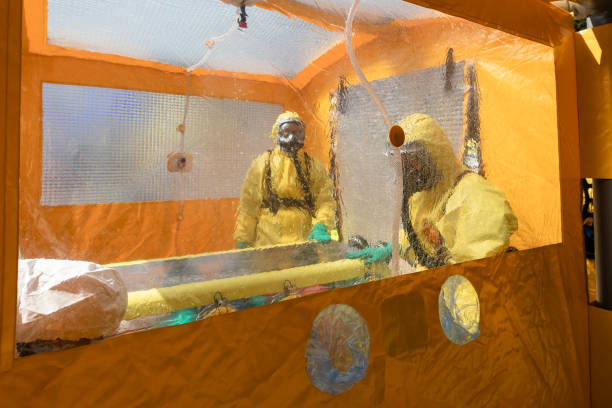
Spread
Like other Orthoebolaviruses, Bundibugyo virus is spread through contact with bodily fluids [5]. Because it is not a respiratory virus in primates, it does not typically spread through aerosols, although Orthoebolaviruses can infect primates when aerosolized [9,10].
Orthoebolaviruses are typically infectious only after symptoms have begun, which usually occurs eight to ten days after exposure, although some people develop symptoms in as few as two days or as many as three weeks [11]. Deceased individuals remain highly infectious because viral load increases until death, with the highest viral load at that time. Field studies from previous outbreaks have shown Ebola RNA can be detected in corpses for days to weeks, and enough evidence exists that public health authorities assume recently deceased Ebola victims remain infectious [12,13]. Orthoebolaviruses have an R around two, meaning each patient infects two others in a naive population [13].
Ebola symptoms begin with fever, nausea, body aches, and tiredness [11], making misdiagnosis as malaria or typhoid fever caused by Salmonella bacteria quite likely [13]. The disease progresses to diarrhea and vomiting, bleeding, organ failure, and death [5,11]. Bundibugyo virus likely has a mortality rate between 30 and 50% [13].
This outbreak is especially worrisome because Bundibugyo lacks any therapeutics or vaccines, the outbreak has affected the major cities of Kampala and Goma, healthcare workers have died after treating unidentified cases, and armed conflict in the DRC hampers public health responses [13]. South Sudan, a neighbor of Uganda and the DRC, is similarly impacted by conflict and migration.
WHO Concerns
This also follows after funding cuts to the WHO, with the US withdrawing from the organisation, dismantling USAID, and major lay-offs of many experts from the CDC [14]. The WHO Chief has also noted that efforts are currently outpaced by the spread of Ebola [15].
Response
Efforts to send aid have been made by Direct Relief, Unicef, Doctors without Borders, and the European Union, among other organizations [16–19]. Cuts to WHO funding, particularly due to the withdrawal of the US from the WHO, and the dissolution of USAID have led to further concerns around containment of the virus; although US officials claim that funding changes did not affect the response, former USAID officials and anonymous sources stated that funding, personnel, and trust in the region have been starkly depleted, contributing to the slowness of the response [20].
Contact tracing has previously been a central component to the containment of Ebola, paired with travel restriction to prevent the spread of the virus as cases for this strain have been growing rapidly [21]. Since traditional contact tracing can be time-intensive and incomplete, especially when individuals in urban areas have many untraceable contacts, a program of early detection led by community health workers can be especially effective in exponentially reducing the spread of Ebola [21]. This policy requires enough effective personal protective equipment to prevent spread of Ebola to and through these community health workers.
References
[1] https://www.bbc.com/news/articles/c759knxln0wo
[4] https://www.cdc.gov/port-health/media/pdfs/2026-05-18-Title-42-Order.pdf
[5] https://www.bbc.com/news/articles/cwy2g197dp8o
[6] https://www.cbsnews.com/news/ebola-uganda-congo-infections-cases-suspected/
[7] https://apnews.com/article/ebola-congo-tents-treatment-fire-e6fb1898865ba6848aa1567aebe7ba30
[8] https://www.cnn.com/2026/05/27/health/ebola-kenya-trump-administration
[10] https://www.nature.com/articles/srep00811
[11] https://www.cdc.gov/ebola/about/index.html
[12] https://pmc.ncbi.nlm.nih.gov/articles/PMC4412251/
[13] https://www.npr.org/2026/05/20/nx-s1-5826910/ebola-outbreak-africa-risks
[14] https://www.theatlantic.com/health/2026/05/ebola-outbreak/687216/
[16] https://www.directrelief.org/2026/05/direct-relief-ebola-outbreak-drc-goma-medical-aid/
[17] https://news.un.org/en/story/2026/05/1167567
[20] https://www.cnn.com/2026/05/22/africa/ebola-us-aid-cuts-drc-uganda-intl
[21] https://pmc.ncbi.nlm.nih.gov/articles/PMC4946441/
Version française / French translation
Éclosion d’Ebola
Rédigé par : Ifrah Ahmad, Claire Alexander, Katelyn Miyasaki
Chronologie
L’éclosion d’Ebola actuelle a couvé pendant plusieurs semaines avant d’être identifiée, ce qui rend sa chronologie difficile à reconstituer avec précision. Selon le Mouvement international de la Croix-Rouge et du Croissant-Rouge, trois bénévoles de la Croix-Rouge sont décédés d’Ebola après avoir été exposés à des corps infectés à la fin du mois de mars [1]. Le premier décès identifié dans cette éclosion est celui d’un travailleur de la santé, décédé à Bunia, en République démocratique du Congo (RDC), à la fin du mois d’avril, puis inhumé à Mongbwalu. Un contact étroit de cette personne est décédé quelques jours plus tard. Le 30 avril, des échantillons prélevés à Bunia se sont révélés négatifs pour le virus Ebola Zaïre [2].
Au moment où l’OMS a été informée de l’éclosion, le 5 mai, plus de 50 personnes étaient déjà décédées, dont plusieurs travailleurs de la santé. Le 11 mai, un homme congolais se trouvant à Kampala, en Ouganda (soit à environ 1 100 kilomètres des zones initiales) a présenté des symptômes d’Ebola. Il est décédé trois jours plus tard. Le 13 mai, l’OMS a déployé une équipe d’intervention rapide à Mongbwalu et à Rwampara [2].
Le 15 mai, 8 des 13 échantillons testés à Kampala se sont révélés positifs au virus de Bundibugyo, ce qui a conduit le ministère congolais de la Santé à déclarer officiellement une éclosion d’Ebola. À ce stade, on comptait 246 cas soupçonnés et 65 décès en RDC, ainsi que deux cas en Ouganda liés à des déplacements depuis la RDC [2]. Le 17 mai, l’OMS a déterminé que l’épidémie constituait une urgence de santé publique de portée internationale, le niveau d’alerte le plus élevé, hors pandémie [3].
Le 18 mai, les Centers for Disease Control and Prevention des États-Unis, sous la direction intérimaire du directeur du NIH, le Dr Jay Bhattacharya, ont annoncé une ordonnance qui repose sur le titre 42, restreignant les déplacements vers les États-Unis en provenance de la République démocratique du Congo, de l’Ouganda et du Soudan du Sud [4].
Au 20 mai, on comptait 600 cas soupçonnés et 139 décès suspects, ainsi que 51 cas confirmés en République démocratique du Congo [5]. Le 22 mai, l’OMS a relevé le niveau de risque pour la RDC à « très élevé » [1].
En raison des tensions liées à l’équilibre entre respect des pratiques funéraires et impératifs de sécurité, certaines communautés ont réagi violemment contre les centres de traitement. Le 21 mai, un centre de traitement a été incendié à Rwampara. Le 23 mai, une tente de soins a été brûlée à Mongbwalu, entraînant la perte de suivi de 18 patients qu’on soupçonnait atteints du virus de Bundibugyo [6]. Une troisième attaque contre des structures de santé a eu lieu le 24 mai [7].
Au 25 mai, on dénombrait 900 cas soupçonnés, dont 7 en Ouganda, certains ayant été contractés sur le territoire ougandais. Les cas confirmés dans la province de l’Ituri, en RDC, dépassaient les 100, et le pays rapportait 220 décès qu’on soupçonne être liés à Ebola [6].
Au 27 mai, l’Ouganda a fermé sa frontière avec la RDC en raison des préoccupations liées à l’épidémie, n’autorisant l’entrée qu’aux « équipes d’intervention Ebola autorisées, aux opérations humanitaires, aux transports de nourriture et de marchandises, ainsi qu’au personnel de sécurité essentiel », soumis à un « contrôle sanitaire strict » et à une « surveillance continue », ainsi qu’à une quarantaine obligatoire de 21 jours [8].
Propagation
Comme les autres orthoebolavirus, le virus de Bundibugyo se transmet par contact avec les fluides corporels [5]. Étant donné qu’il ne s’agit pas d’un virus respiratoire chez les primates, sa transmission ne se fait généralement pas par aérosols, bien que les orthoebolavirus puissent infecter des primates lorsqu’ils sont aérosolisés [9,10].
Les orthoebolavirus sont habituellement contagieux uniquement après l’apparition des symptômes, qui surviennent généralement entre huit et dix jours après l’exposition, bien que certaines personnes développent des symptômes en seulement deux jours, ou jusqu’à trois semaines plus tard [11]. Les personnes décédées restent hautement infectieuses, car la charge virale augmente jusqu’au décès, où elle atteint son maximum. Des études de terrain menées lors de précédentes éclosions ont montré que l’ARN du virus Ebola peut être détecté dans les corps pendant plusieurs jours à plusieurs semaines, et les données disponibles sont suffisantes pour que les autorités de santé publique considèrent que les dépouilles récentes de victimes d’Ebola demeurent infectieuses [12,13]. Les orthoebolavirus ont un R d’environ 2, ce qui signifie qu’un patient infecte en moyenne deux autres personnes dans une population naïve [13].
Les symptômes d’Ebola commencent par de la fièvre, des nausées, des douleurs corporelles et une grande fatigue [11], ce qui rend une erreur de diagnostic avec le paludisme ou la fièvre typhoïde (causée par la bactérie Salmonella) probable [13]. La maladie évolue ensuite vers des diarrhées et des vomissements, puis vers des hémorragies, une défaillance viscérale et la mort [5,11]. Le virus de Bundibugyo présente probablement un taux de létalité situé entre 30 et 50 % [13].
Cette éclosion est particulièrement préoccupante, car on ne dispose actuellement ni de thérapeutiques ni de vaccin contre le virus de Bundibugyo. L’éclosion touche déjà de grandes villes comme Kampala et Goma. Plusieurs travailleurs de la santé sont décédés après avoir pris en charge des cas non identifiés, et le conflit armé en RDC complique fortement la réponse sanitaire [13]. Le Soudan du Sud, voisin de l’Ouganda et de la RDC, est également affecté par des dynamiques similaires de conflit et de mobilité.
Préoccupations de l’OMS
Cette situation s’inscrit également dans un contexte de réduction des financements de l’OMS en raison du retrait des États-Unis de l’organisation, du démantèlement de l’USAID et d’importantes suppressions de postes parmi les experts des CDC [14]. Le directeur général de l’OMS a également indiqué que la propagation d’Ebola dépasse les efforts actuels [15].
Réponse
Des efforts d’acheminement d’aide ont été entrepris par Direct Relief, l’UNICEF, Médecins Sans Frontières, ainsi que l’Union européenne, entre autres organisations [16–19]. Les réductions de financement de l’OMS, notamment liées au retrait des États-Unis de l’OMS, ainsi que la dissolution de l’USAID, suscitent des inquiétudes supplémentaires quant à la capacité de contenir le virus. Bien que des responsables américains affirment que ces changements n’ont pas affecté la réponse, d’anciens responsables de l’USAID et des sources anonymes indiquent que les ressources financières et humaines, ainsi que la confiance sur le terrain ont été fortement réduites, contribuant à ralentir l’intervention [20].
La recherche des contacts a historiquement constitué un pilier central de la maîtrise d’Ebola, en complément des restrictions de voyage visant à limiter la propagation, dans un contexte où les cas de cette souche augmentent rapidement [21]. Cependant, la recherche de contacts traditionnelle est longue et souvent incomplète, en particulier dans les environnements urbains où les individus ont de nombreux contacts difficilement identifiables. Dans ce contexte, un programme de détection précoce mené par des agents de santé communautaires peut s’avérer particulièrement efficace pour réduire de manière exponentielle la transmission [21]. Cette approche nécessite toutefois un approvisionnement suffisant en équipements de protection individuelle afin d’éviter la transmission d’Ebola aux travailleurs de la santé communautaires et par leur intermédiaire.
Versión en español / Spanish translation
Brote de Ébola
Línea de tiempo
El brote actual de ébola se mantuvo latente durante semanas antes de ser identificado, lo que dificulta determinar su línea de tiempo. Según la Cruz Roja/Media Luna Roja Internacional, tres voluntarios de la Cruz Roja fallecieron a causa del ébola tras haber estado expuestos a cadáveres infectados a finales de marzo [1]. La primera muerte identificada en este brote fue la de un trabajador de la salud que falleció en Bunia, República Democrática del Congo (RDC), a finales de abril y fue enterrado en Mongbwalu. Un contacto cercano falleció a los pocos días. El 30 de abril, las muestras de Bunia dieron negativo para el virus del ébola de Zaire [2].
Para cuando la OMS tuvo conocimiento del brote el 5 de mayo, más de 50 personas ya habían fallecido, incluyendo personal de la salud. El 11 de mayo, un hombre congoleño presentó síntomas de ébola a 1126 kilómetros de distancia, en Kampala, Uganda. Falleció tres días después. El 13 de mayo, la Organización Mundial de la Salud (OMS) desplegó un equipo de respuesta rápida en Mongbwalu y Rwampara [2].
El 15 de mayo, 8 de 13 muestras analizadas en Kampala dieron positivo para el virus Bundibugyo, lo que llevó al Ministerio de Salud del Congo a declarar un brote de ébola. En ese momento, se registraron 246 casos sospechosos y 65 muertes en la República Democrática del Congo, además de dos casos en Uganda derivados de viajes desde la RDC [2]. El 17 de mayo, la OMS determinó que el brote constituía una Emergencia de Salud Pública de Importancia Internacional, el nivel de alerta más alto, con excepción de una pandemia [3].
El 18 de mayo, los Centros para el Control y la Prevención de Enfermedades de Estados Unidos (CDC), bajo la dirección interina del Dr. Jay Bhattacharya, director de los NIH, anunciaron una Orden del Título 42 que restringía los viajes a Estados Unidos desde la República Democrática del Congo, Uganda y Sudán del Sur [4].
Para el 20 de mayo, se registraron 600 casos sospechosos y 139 muertes sospechosas, con 51 casos confirmados en la República Democrática del Congo [5]. El 22 de mayo, la OMS actualizó el nivel de riesgo de la RDC a “muy alto” [1].
Debido a las tensiones en torno al equilibrio entre el respeto y la seguridad en los entierros, algunas comunidades han reaccionado violentamente contra los centros de tratamiento. El 21 de mayo, un centro de tratamiento fue incendiado en Rwampara. El 23 de mayo, una tienda de campaña de tratamiento fue incendiada en Mongbwalu, lo que provocó que los trabajadores de la salud perdieran el rastro de 18 pacientes sospechosos de infección por el virus Bundibugyo [6]. Un tercer ataque contra centros de salud tuvo lugar el 24 de mayo [7].
Al 25 de mayo, hay 900 casos sospechosos, incluidos 7 casos sospechosos en Uganda, algunos de los cuales se contrajeron dentro de Uganda. Los casos confirmados en la provincia de Ituri, República Democrática del Congo, superaron los 100, y la RDC reportó 220 muertes sospechosas por ébola [6].
Al 27 de mayo, Uganda cerró su frontera con la RDC en medio de preocupaciones por el ébola, permitiendo solo la entrada a “equipos autorizados de respuesta al ébola, operaciones humanitarias, transporte de alimentos y carga, y personal de seguridad esencial” que también deberán someterse a “controles de salud estrictos” y “monitoreo continuo”, y un aislamiento obligatorio de 21 días [8].
Propagación
Al igual que otros ortoebolavirus, el virus Bundibugyo se transmite por contacto con fluidos corporales [5]. Dado que no es un virus respiratorio en primates, no suele propagarse por aerosoles, aunque los ortoebolavirus pueden infectar a los primates cuando se aerosolizan [9,10].
Los ortoebolavirus suelen ser infecciosos solo después de que han comenzado los síntomas, lo que generalmente ocurre de ocho a diez días después de la exposición, aunque algunas personas desarrollan síntomas en tan solo dos días o hasta tres semanas [11]. Los individuos fallecidos siguen siendo altamente infecciosos porque la carga viral aumenta hasta la muerte, alcanzando su nivel máximo en ese momento. Estudios de campo de brotes anteriores han demostrado que el ARN del ébola puede detectarse en cadáveres durante días o semanas, y existe suficiente evidencia para que las autoridades de salud pública asuman que las víctimas de ébola recientemente fallecidas siguen siendo infecciosas [12,13]. Los ortoebolavirus tienen un R de alrededor de dos, lo que significa que cada paciente infecta a otras dos personas en una población sin exposición previa [13].
Los síntomas del ébola comienzan con fiebre, náuseas, dolores corporales y cansancio [11], lo que hace que sea muy probable un diagnóstico erróneo como malaria o fiebre tifoidea causada por la bacteria Salmonella [13]. La enfermedad progresa a diarrea y vómitos, hemorragias, insuficiencia orgánica y muerte [5,11]. El virus Bundibugyo probablemente tiene una tasa de mortalidad de entre el 30 y el 50 % [13].
Este brote es especialmente preocupante porque no existen tratamientos específicos ni vacunas contra Bundibugyo, el brote ha afectado a las principales ciudades de Kampala y Goma, han fallecido trabajadores de la salud tras tratar casos no identificados y el conflicto armado en la RDC dificulta las respuestas de salud pública [13]. Sudán del Sur, país vecino de Uganda y la RDC, se ve igualmente afectado por el conflicto y la migración.
Preocupaciones de la OMS
Esto también se produce tras los recortes de financiación a la OMS, con la retirada de Estados Unidos de la organización, el desmantelamiento de USAID y los importantes despidos de muchos expertos de los CDC [14]. El director general de la OMS también ha señalado que los esfuerzos se ven actualmente superados por la propagación del ébola [15].
Respuesta
Direct Relief, UNICEF, Médicos Sin Fronteras y la Unión Europea, entre otras organizaciones, han realizado esfuerzos para enviar ayuda [16–19]. Los recortes en la financiación de la OMS, en particular debido a la retirada de Estados Unidos de la OMS y la disolución de USAID, han generado mayor preocupación en torno a la contención del virus; aunque los funcionarios estadounidenses afirman que los cambios en la financiación no afectaron la respuesta, antiguos funcionarios de USAID y fuentes anónimas declararon que la financiación, el personal y la confianza en la región se han agotado drásticamente, lo que ha contribuido a la lentitud de la respuesta [20].
El rastreo de contactos ha sido un componente fundamental para la contención del ébola, junto con la restricción de viajes para prevenir la propagación del virus, debido al rápido aumento de casos de esta cepa [21]. Dado que el rastreo de contactos tradicional puede ser laborioso e incompleto, especialmente cuando las personas en áreas urbanas tienen muchos contactos imposibles de rastrear, un programa de detección temprana liderado por trabajadores de salud comunitarios puede ser particularmente eficaz para reducir exponencialmente la propagación del ébola [21]. Esta política requiere suficiente equipo de protección personal eficaz para prevenir la propagación del ébola a estos trabajadores de salud comunitarios y a través de ellos.